TL;DR
Netcoins now offers a direct coin conversion feature across its WebApp and mobile apps, letting you convert one cryptocurrency into another without first converting to Canadian dollars. The update is built on an integration with Talos, an institutional trading infrastructure provider, and is designed to simplify portfolio rebalancing. Crypto prices are volatile and the value of any conversion can move quickly, so it is worth understanding how quotes, spreads, and slippage work before you trade. Canada's digital asset market has matured quickly. Most new investors start by learning how to buy Bitcoin in Canada and funding an account with Canadian dollars through Interac e-Transfer. As people move from beginner to intermediate, their needs shift toward rebalancing between assets. This guide explains what a coin conversion is, how market mechanics affect your rate, and exactly how to convert coins on Netcoins, with screenshots for each step.
Understanding Crypto Conversions: What Does It Mean to Convert Coins?
A crypto conversion is the direct exchange of one cryptocurrency for another at the prevailing market rate, without using a fiat currency such as CAD or USD as a bridge between the two digital assets. In plain terms, you hand over one coin and receive another in a single action.
To see why this matters, it helps to contrast a conversion with traditional order book trading. On a standard exchange, trades are matched through an order book that pairs buyers and sellers for specific pairs, most often a coin against a fiat currency like BTC/CAD. If you held Ethereum (ETH) and wanted Solana (SOL) on a platform that only offered fiat pairs, you would run two separate trades. First you would sell ETH for CAD. Once that settled, you would use the CAD to buy SOL.
A direct coin conversion collapses that two-step process into one. The underlying market still needs liquidity to fill the exchange, but the interface and the backend routing handle that complexity for you. The system calculates the cross-rate between the two assets and delivers the new coin into your portfolio.
This model was first popularized in decentralized finance, where automated market makers let people convert tokens straight from self-custody wallets. If you are new to these ideas, our beginner's guide to cryptocurrency is a good starting point. Bringing that convenience to a centralized platform requires more infrastructure, because the platform has to source pricing and liquidity while shielding users from the technical risks of interacting with smart contracts directly.
A common Canadian use case is moving into a stablecoin. Some investors shift value into a stablecoin such as USD Coin (USDC) during choppy markets. It is important to understand that stablecoins aim to track the value of a reference currency like the US dollar, but they are not the same as holding cash. Their value is not guaranteed, and they can carry issuer, reserve, redemption, liquidity, and regulatory risks. A stablecoin can trade below its intended value during periods of market stress. Treat any conversion into a stablecoin as a trade with its own risks, not as a risk-free parking spot.
Why Direct Conversion Matters: The Inefficiency of the Fiat Bridge
Understanding the inefficiency of the traditional "fiat bridge" helps explain why direct conversion can be more convenient. When you sell one coin for Canadian dollars and immediately buy a different coin with those dollars, you add friction to what could be a single step.
Every order on an order book crosses the bid-ask spread, a concept covered in the next section. When you sell your first coin for CAD, you cross the spread once. When you use that CAD to buy the new coin, you cross the spread again. This double exposure acts as an implicit cost that can chip away at value, and it also takes more time in a market that runs 24 hours a day.
By using the direct conversion feature, the platform calculates the cross-rate between the two assets and removes the fiat middle step. For a Vancouver or Toronto investor rebalancing a portfolio on a busy morning, that means fewer steps and a single execution rather than two. The result is a more streamlined way to move between assets. As always, the exact amount you receive depends on live market conditions, so review the quote before you confirm.
The Core Market Mechanics: Liquidity, Spreads, and Slippage
To use the conversion feature with confidence, it helps to understand three connected concepts: liquidity, the bid-ask spread, and slippage. Together they shape the final amount of crypto that lands in your account, whether you are converting a large position or a fraction of a token in Calgary or Halifax.
Liquidity: The Depth of the Market
Liquidity is how easily an asset can be bought, sold, or converted without causing a large change in its price. Picture a deep ocean. Drop a boulder in and it barely makes a ripple. That is a highly liquid market. Drop the same boulder into a small puddle and water splashes everywhere. That is a low-liquidity market.
Highly liquid pairs, such as a conversion between Bitcoin (BTC) and Ethereum (ETH), have deep pools of buyers and sellers, which makes large conversions easier to fill. Smaller or less-traded tokens can have thinner liquidity, so there may not be enough counterparties to fill an order at the exact rate you expected. That is where the spread comes in.
The Bid-Ask Spread: The Cost of Immediate Execution
The bid-ask spread is a pricing mechanism found in every financial market. It is the difference between the highest price a buyer is willing to pay (the bid) and the lowest price a seller is willing to accept (the ask). Because the highest bid is almost always lower than the lowest ask, a gap exists.
When you request an immediate conversion, you cross that gap, so the spread acts as an implicit transaction cost. In active, liquid markets the spread tends to be tight, so the cost is smaller. In volatile or illiquid markets, market makers widen the spread to protect against rapid price swings, which makes conversions more expensive.
Slippage: The Reality of Fast-Moving Markets
Slippage is the difference between the price you expect when you start a conversion and the actual price when it executes. Crypto markets move in seconds, driven by global news and demand. In the short window between reviewing a quote and confirming it, the market price can shift.
Slippage can go either way. With negative slippage, the price moves against you during execution, so your capital buys slightly less of the target coin than estimated. With positive slippage, the price moves in your favour, so you receive slightly more. To manage this, trading systems often use a slippage tolerance, a setting that defines the maximum price deviation you are willing to accept. If the execution price moves beyond that threshold, the conversion can be cancelled so you are not locked into a rate far from the quote.
How Netcoins Powers Conversions: The Talos Integration
Offering a simple one-tap conversion to everyday investors requires capable backend infrastructure. To bring coin-to-coin conversions to Canada, Netcoins integrated with Talos, described as a provider of institutional-grade digital asset trading infrastructure. The integration went live in 2026 and added coin-to-coin conversion functionality, USD-denominated funding and pairs, and access to a broader set of liquidity venues [Source].
The integration provides smart order routing and multi-venue connectivity. Instead of relying on a single order book, the routing engine can scan an aggregated network of liquidity providers and venues to help find competitive pricing for a given pair. This is the same category of infrastructure that institutional trading desks use.
For a retail investor in Vancouver, Toronto, or a growing tech hub like Kitchener-Waterloo, the practical effect is access to institutional-style routing from a phone or browser. Multi-venue connectivity is designed to help source deeper liquidity for larger conversions and to support more competitive quotes. It does not remove market risk. Prices still move, spreads still apply, and the amount you receive depends on live conditions at the moment of execution. The quote you see on screen is the best guide to what you will get, which is why the preview screen is the most important step in the flow.
Step-by-Step Guide: How to Convert Coins on Netcoins
The conversion feature works the same way across devices. Whether you use the desktop WebApp or the iOS or Android app, the steps below are identical. The screenshots come from the mobile app.
Step 1: Log in and open the Convert screen
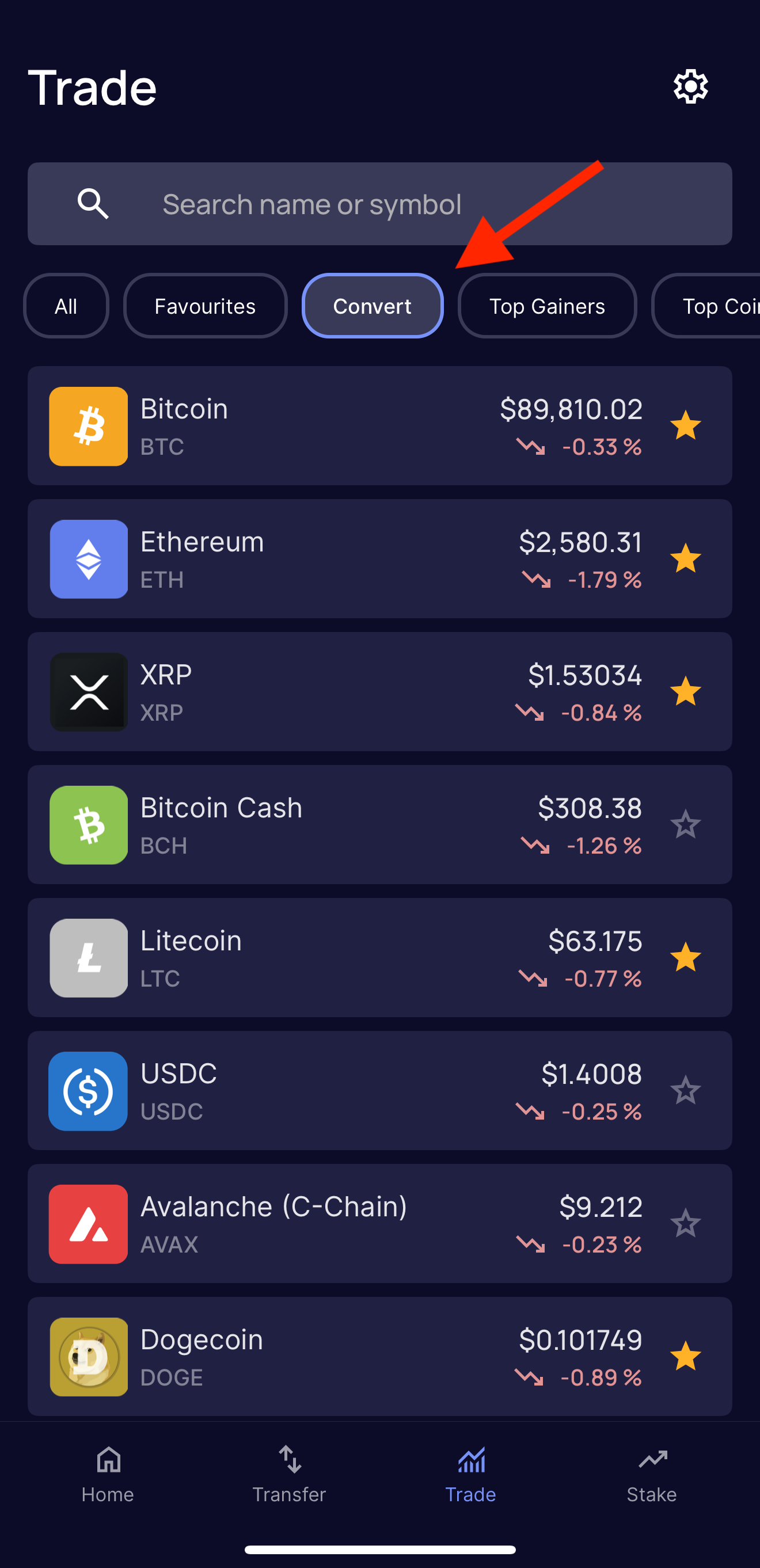
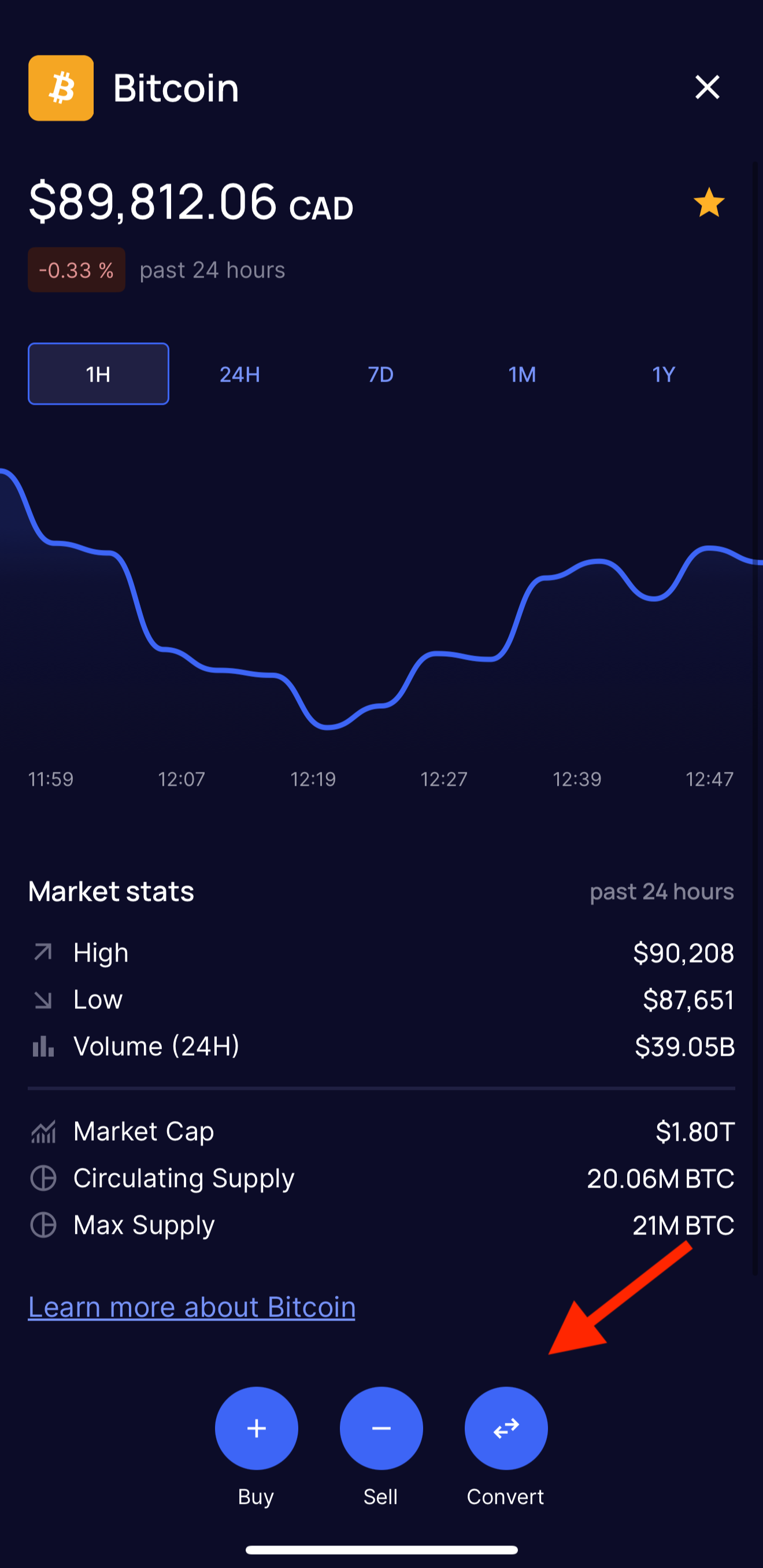
Log in to your Netcoins account and go to your portfolio dashboard. On the WebApp, use the top or side navigation. On mobile, use the bottom menu. Open the Convert screen to enter the conversion flow. Depending on your app version, this feature may appear labelled as Swap. You can also start a conversion directly from a coin's market page. When viewing an asset like Ethereum, look for the action buttons at the bottom of the screen, then tap the convert action to pre-fill that asset in the "From" field. If you are curious about the Stake option you see here, our guide to crypto staking explains how it works.
Step 2: Select your coin pair
Inside the Convert screen you will see two fields labelled "From" and "To." In the "From" field, choose the coin you currently hold and want to convert, for example Ethereum (ETH). In the "To" field, choose the coin you want to receive, for example USD Coin (USDC). Use the search bar to find an asset from the growing range Netcoins supports.
The small up-and-down arrow lets you switch which asset the amount is entered in. Tapping it flips the input so you can size the conversion in the coin you are receiving instead of the one you are spending.
Step 3: Enter the conversion amount
Type the amount you want to convert using the on-screen keypad on mobile or your keyboard on desktop. As you type, the app calculates an estimated amount of the "To" asset in real time. To convert your whole balance of that coin, use the quick percentage buttons above the keypad and select Max.
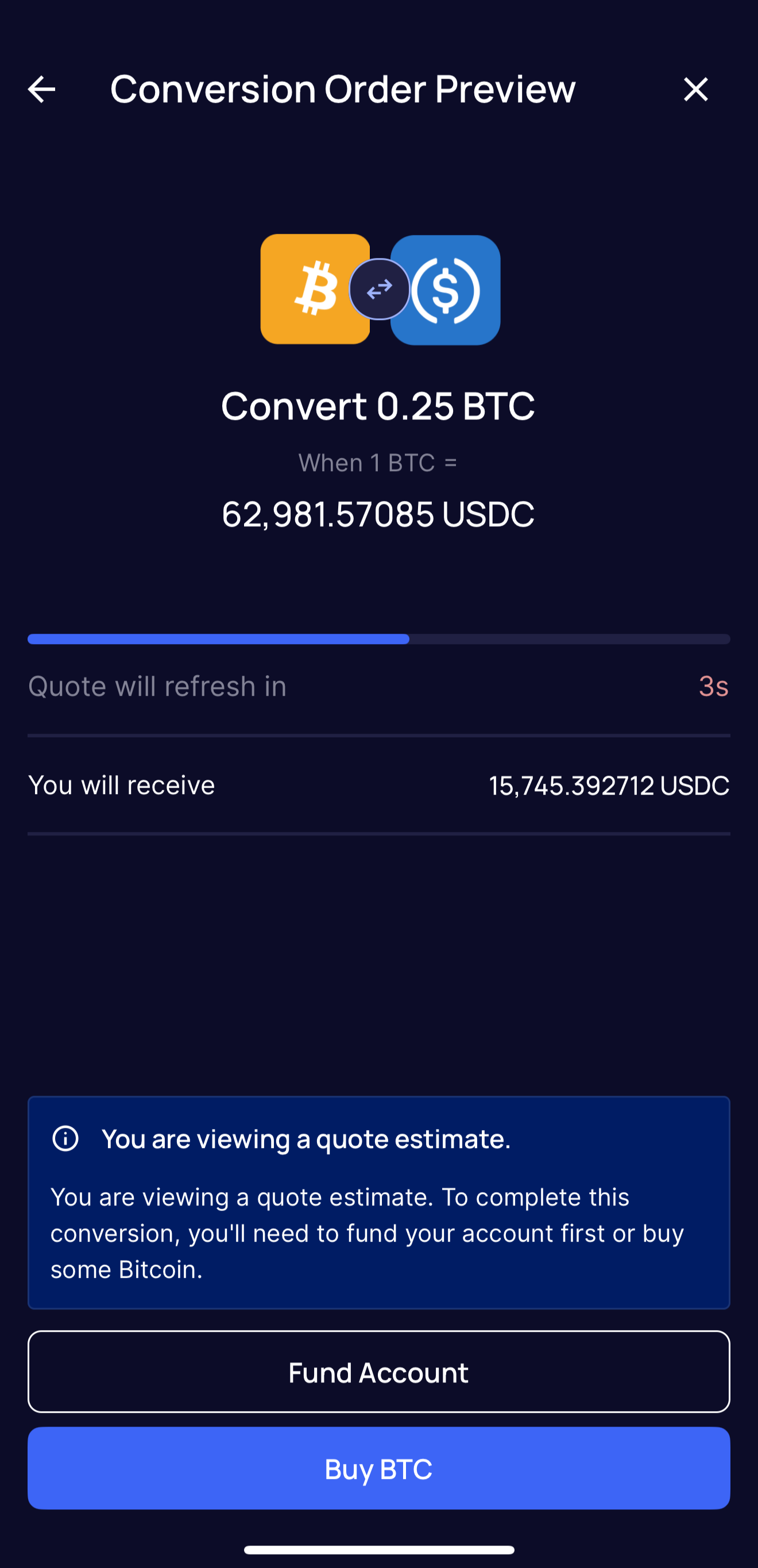
Note: if your balance is not enough to cover the conversion, the app shows a quote estimate and prompts you to fund your account before you can lock in a price and place the order.
Step 4: Review the quote on the order preview
Next you reach the order preview, the final check before you commit. This screen shows the amount you are spending, the estimated amount you will receive, the conversion rate (for example, when 1 ETH equals a set amount of USDC), and a short countdown timer showing how long the quote is valid before it refreshes. The quoted price already reflects the bid-ask spread for current market conditions and available liquidity, so read it carefully before continuing.
Step 5: Place the order and confirm
If you are satisfied with the quote, tap Place Order. The app shows a brief processing screen while the order is routed and executed, then displays a success confirmation. This screen is your digital receipt. It shows the final amounts exchanged, the execution rate, and a unique Order Number for your records. Tap Done to return to your dashboard, where your balances update to reflect the conversion.
Step 6: Review your transaction history
To keep track of your activity, open the All Transactions tab. There you can see a chronological list of every deposit, withdrawal, trade, and conversion. Tapping any conversion opens a Transaction Details screen with a permanent record of the rate and amounts for that conversion.
The Benefits of Direct Coin Conversions for Canadian Investors
Direct conversion is more than an interface refresh. It changes how you can move between assets on the platform.
First, it saves steps. In a market where sentiment can shift quickly, the older approach of selling to fiat and buying back takes more time and more actions. A direct conversion lets you rebalance in a single execution rather than two.
Second, it simplifies diversification. Netcoins supports a growing range of cryptocurrencies and regularly reviews new assets. Direct conversion lets you shift exposure across sectors without manually calculating fiat rates between each move. For an investor comparing platforms and features, our overview of the best Canadian crypto exchanges provides useful context.
Third, by skipping the Canadian dollar as a middle step, you avoid crossing the bid-ask spread twice on a rebalance. None of this removes market risk. Crypto values are volatile, quotes change, and the amount you receive depends on conditions at the moment you confirm. Direct conversion makes the process simpler, not risk-free. Consider your own goals and risk tolerance before you trade.
Security and Custody: Protecting Your Converted Digital Assets
As you become more active in converting assets, it helps to understand how crypto wallets work and how your coins are held. Converting on a platform like Netcoins means you are not interacting directly with smart contracts or managing your own private keys, which removes some of the operational steps and risks specific to decentralized conversions, such as phishing and malicious contract approvals. This does not remove market risk or make crypto safe, and it shifts custody responsibility to the platform rather than eliminating risk.
According to Netcoins' published information on its security measures, the platform uses a dual custody model to help protect client funds. Specific providers, certifications, and arrangements can change, so confirm the current details on Netcoins' official pages:
- Hot wallet security: For assets needed to support daily trading and conversions, Netcoins works with Fireblocks, an infrastructure provider that uses multi-party computation cryptography to help secure assets in transit.
- Cold storage: Netcoins reports that the majority of client funds are held offline in cold storage with BitGo, which can reduce exposure to network-based threats. Cold storage lowers some risks but does not eliminate them. Both custodial cold storage and personal self-custody still carry operational, fraud, loss, and cybersecurity risks.
Security also includes regulation. Netcoins is a Canadian platform founded in 2014 in Vancouver, British Columbia, and is a subsidiary of BIGG Digital Assets (TSXV: BIGG). Netcoins Inc. is registered as a restricted dealer under securities legislation in applicable Canadian jurisdictions. Regulatory status, custody arrangements, and security practices can change over time, so check Netcoins' official pages for the current details. No security model removes all risk, and holding crypto always involves risk. Location or registration alone does not guarantee safety or investor protection.
People Also Ask About Converting Crypto on Netcoins
What is the difference between a crypto conversion and a crypto trade?
A crypto conversion is a direct exchange of one coin for another, such as Ethereum for Solana, that skips converting to a fiat currency like the Canadian dollar. A traditional trade usually involves an order book where buyers and sellers place orders, most often trading a fiat currency against a digital asset. A conversion combines what would otherwise be two fiat-bridged trades into one action, while a trade is a single side of an order book.
Does converting cryptocurrency on the platform cost money?
Coin conversions are subject to the bid-ask spread and potential slippage, which act as the implicit cost of executing immediately at market. The spread is the difference between the buying and selling price at that moment. The order preview shows the rate you are being quoted, and you should review it before confirming. For current fee details, check Netcoins' published fee information.
Can I convert any coin to any other coin on the app?
The ability to convert between two specific assets depends on market liquidity. With multi-venue connectivity, many pairs can be routed efficiently, but some smaller or less-traded tokens may be routed through a more liquid asset such as Bitcoin or USDC behind the scenes to complete the conversion. If a pair is unavailable, the app will indicate that at the quote stage.
What happens if the price changes while I am converting?
Because prices move continuously, the market can shift in the brief window between starting a conversion and completing it. This is called slippage. If the price moves beyond an acceptable tolerance before the trade settles, the system can cancel the order to protect you from a rate far from the quote. Reviewing the quote and its countdown timer helps you act while the price is still valid.
Do I need a separate wallet to convert coins?
No. You do not need an external self-custody wallet to convert coins on Netcoins. The conversion happens inside your verified account, and the resulting assets are held in your platform portfolio under the custody arrangements described above. Moving holdings to a personal wallet is a separate decision from converting. Self-custody carries its own responsibilities and risks, including permanent loss of access if keys or recovery phrases are lost, so it is not inherently safer than using a platform.
Frequently Asked Questions
How long does a crypto conversion take on the Netcoins app?
Conversions are designed to complete quickly. After you review the quote and confirm, the system routes the order and settles it, and your balance updates to reflect the new asset. Exact timing can vary with market conditions, but the flow is built to feel near-instant for the user.
What is slippage tolerance?
Slippage tolerance is a protective setting that defines the maximum price movement you are willing to accept during a conversion. If the execution price moves outside that range before the trade settles, the conversion can be cancelled. This helps prevent you from being locked into a rate that is far from what you were quoted during a sudden market move.
Is it better to convert coins directly or sell to CAD first?
From a simplicity standpoint, a direct conversion combines two steps into one and avoids crossing the bid-ask spread twice. Whether that is right for you depends on your goals, the assets involved, and current market conditions. This is general information, not financial advice, so consider your own situation before deciding.
Can I use the convert feature on both iOS and Android?
Yes. The conversion feature is available across the Netcoins WebApp, iOS, and Android. The interface and steps are consistent, so you can start a conversion on your phone in Ottawa and review your history later on the desktop WebApp.
What does multi-venue connectivity mean?
It means the routing engine can look across an aggregated network of liquidity providers and venues rather than a single order book when pricing your conversion. The goal is to help find competitive pricing and deeper liquidity for a given pair. It does not guarantee a specific price, since markets move in real time.
Quick Glossary
Convert (coin conversion): The direct exchange of one cryptocurrency for another without using a fiat currency as an intermediary step.
Liquidity: How easily an asset can be bought, sold, or converted without causing a large change in its price.
Bid-Ask Spread: The difference between the highest price a buyer will pay (the bid) and the lowest price a seller will accept (the ask).
Slippage: The difference between the expected price of a conversion and the actual price at which it executes, caused by real-time market movement.
Slippage Tolerance: A setting that defines the maximum price movement you will accept during a conversion before the trade is cancelled.
Smart Order Routing: An automated process that scans multiple venues to help find available liquidity and competitive pricing for an order.
Stablecoin: A cryptocurrency that aims to track the value of a reference asset such as the US dollar. Its value is not guaranteed and it carries its own risks.
Cold Storage: A security method where the keys to digital assets are kept offline to reduce exposure to network-based threats.
Key Takeaways
- The Netcoins WebApp and mobile apps now let Canadian users convert one cryptocurrency directly into another, without converting back to Canadian dollars first.
- The feature is built on an integration with Talos and uses smart order routing and multi-venue connectivity to help source pricing and liquidity.
- Understanding liquidity, the bid-ask spread, and slippage helps you see how your conversion rate is set and why the quoted amount can change.
- The order preview shows your rate and a countdown timer, so review it before you place an order. Crypto is volatile and outcomes are never guaranteed.
- Converted assets stay within your Netcoins account under a dual custody model using Fireblocks and BitGo, which reduces some operational risks of self-managed conversions.
Closing
Moving between digital assets should be simple to do and clear to understand. The direct coin conversion feature on the Netcoins WebApp and mobile apps gives Canadian investors a more streamlined way to rebalance a portfolio, while the quote and preview screens keep the process transparent. Understanding conversions, spreads, and slippage helps you make more informed decisions and set realistic expectations, since crypto prices are volatile and no conversion is risk-free. If you are still getting started, our step-by-step guide for Canadians on buying Bitcoin and our overview of how Interac e-Transfer works for crypto in Canada are useful next reads.

About Netcoins
Established in 2014 in Vancouver, British Columbia, Netcoins is a registered Restricted Dealer with the provincial securities commissions and a registered Money Services Business (MSB) with FINTRAC. Netcoins is owned by Surge Digital Inc. (formerly BIGG Digital Assets Inc.), a publicly traded company listed on the TSX Venture Exchange (TSXV: SRGE), and complies with applicable public company regulatory.
The information provided in the blog posts on this platform is for educational purposes only. It is not intended to be financial advice or a recommendation to buy, sell, or hold any cryptocurrency. Always do your own research and consult with a professional financial advisor before making any investment decisions. Cryptocurrency investments carry a high degree of risk, including the risk of total loss. The blog posts on this platform are not investment advice and do not guarantee any returns. Any action you take based on the information on our platform is strictly at your own risk. The content of our blog posts reflects the authors’ opinions based on their personal experiences and research. However, the rapidly changing and volatile nature of the cryptocurrency market means that the information and opinions presented may quickly become outdated or irrelevant. Always verify the current state of the market before making any decisions.