
TL;DR Staking lets cryptocurrency holders lock assets to support a Proof-of-Stake network and earn protocol-generated rewards in return. Bonding and unbonding periods are set primarily by the blockchain protocol itself, though the platform you use may add its own processing steps on top. Canadian investors can stake supported assets, including Ethereum, Solana, and Cosmos, through a domestic platform that manages the technical side of running validator infrastructure, though using a regulated platform does not remove staking's underlying risks. Crypto staking works by locking a digital asset so it can help validate transactions on a Proof-of-Stake network, in exchange for rewards generated by that network's own rules. This guide explains how Proof-of-Stake consensus works, what bonding and unbonding periods mean for liquidity, which major assets currently support staking, and the risks involved, including price volatility, illiquidity, slashing, and custody risk, which are covered in detail later in this article.
How Staking Rewards Affect Token Holdings Over Time
Staking changes a holding's token count over time, since rewards are paid in additional units of the staked asset, but this is a separate mechanic from the asset's market price, which staking does not influence or protect.
Proof-of-Stake networks issue new tokens to participants who lock assets and help validate transactions, at a rate set by each network's own protocol rules [Source]. This is a mechanical, protocol-level process, not a trading strategy: the reward rate is determined by network rules such as total participation and issuance schedule, not by market conditions or timing decisions made by the holder.
The distinction between token count and token value matters technically. If a Canadian investor holds a digital asset priced in Canadian Dollars (CAD) and stakes it, the number of tokens held increases over time according to the network's reward schedule. The CAD value of the holding, however, is set entirely by the asset's market price, which staking has no effect on. If the market price falls faster than the token count grows, the CAD value of the holding decreases, regardless of how many rewards were earned. Staking is a mechanism for token accumulation. It is not a mechanism for managing or reducing price risk.
This distinction is why staking rewards and trading gains are measured differently. A trade's outcome depends on price movement and timing. A staking reward is issued on a schedule defined by the protocol, calculated as a function of the amount staked and network-wide participation, independent of the asset's price. The risks specific to staking, including price volatility, illiquidity, slashing, and custody risk, are covered in full later in this article.
Understanding Proof-of-Stake and Network Consensus
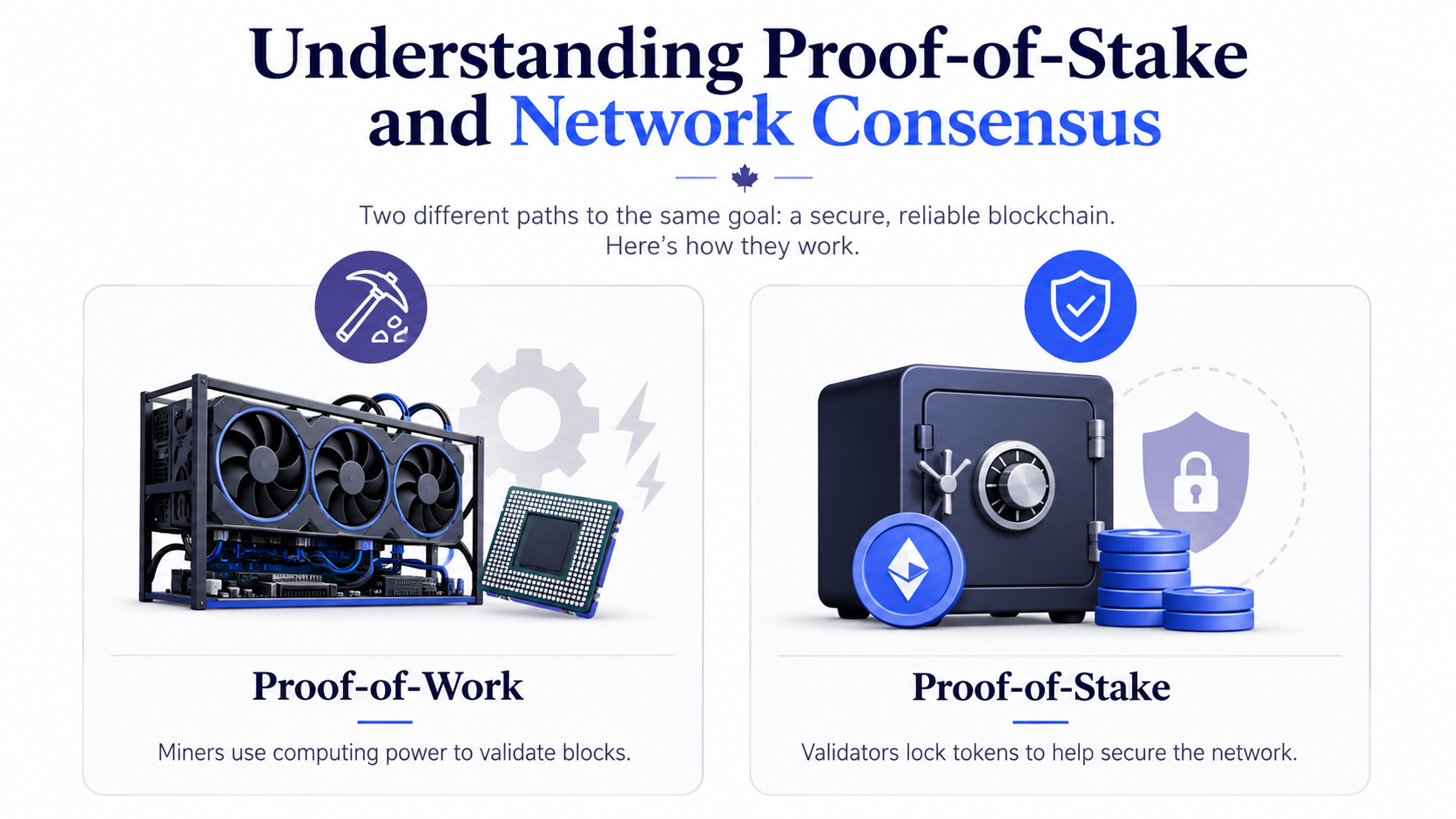
Proof-of-Stake is a blockchain consensus mechanism that uses locked economic capital, rather than computing power, to secure the network and validate transactions.
Blockchains have no central authority to verify balances or approve transactions, so they rely on automated consensus mechanisms to keep every node in agreement about the state of the ledger. The original approach, Proof-of-Work (PoW), used by Bitcoin, has participants compete using specialized hardware to solve computational puzzles, with the winner earning the right to add the next block. This method is well tested but energy-intensive.
Proof-of-Stake takes a different approach. Instead of computing power, participants lock a set amount of the network's native token into a smart contract as a form of security deposit, commonly called a "stake." The protocol then selects a validator to propose the next block, with the odds of selection generally increasing alongside the size of a validator's stake. A larger stake tends to mean more frequent block proposals and more frequent rewards.
Security in a Proof-of-Stake network relies on a penalty mechanism called slashing. If a validator approves invalid transactions, behaves dishonestly, or experiences extended downtime, the protocol can automatically confiscate a portion of that validator's staked collateral. This creates a strong financial incentive to run reliable, honest infrastructure, since the cost of misbehaving is tied directly to the market value of what is staked. For an Ontario-based investor comparing networks, this slashing mechanism is one reason validator quality matters, whether staking independently or through a platform, and it is a cost that is ultimately borne by whoever owns the staked assets, discussed further below.
Bonding and Unbonding Periods Explained
.png)
Bonding and unbonding periods are waiting times set primarily by each blockchain's own protocol rules, which determine when a staked asset starts earning rewards and when it can be withdrawn, though the platform you use may add its own processing time or display an estimated rather than exact figure.
A common misconception is that staked assets can be deposited and withdrawn as instantly as a bank balance. In practice, participating in blockchain consensus involves waiting periods written into the protocol itself, designed to prevent large, rapid shifts of capital that could be used to manipulate the network. These timelines originate at the blockchain level, but the specific figure shown to you on any given platform is typically presented as an estimate, since it can be affected by validator queues, network congestion, and the platform's own processing steps.
Approximate bonding and unbonding timelines for major networks include:
- Ethereum (ETH): a bonding period of roughly three days before staked ETH becomes active, and an unbonding period that has varied with network conditions, generally in the range of days depending on the validator exit queue at the time.
- Solana (SOL): both bonding and unbonding are tied to Solana's roughly two-day epochs, so activation and withdrawal each typically take about one epoch.
- Cosmos (ATOM): bonding is close to instant, but the protocol enforces a fixed 21-day unbonding period before staked ATOM can be withdrawn.
These figures are estimates. Actual timelines shift with validator queues and network congestion, and the platform you use may display its own estimated processing time on top of the network figure, so always confirm the current estimate shown in your account before staking or unstaking.
The bonding period begins the moment a staking transaction is submitted. During this window, the asset is locked but not yet actively validating, and it does not earn rewards until the bonding period fully elapses. This delay exists specifically to prevent malicious actors from rapidly moving large amounts of capital in and out of the network to influence consensus.
The unbonding period works differently. Once an investor initiates an unstaking request, the asset stops earning rewards immediately but remains locked and untradeable until the unbonding period ends. This exists so the network has time to detect and penalize any validator misconduct before funds can be withdrawn. If the broader market drops sharply while assets sit in a multi-day or multi-week unbonding queue, those assets cannot be sold to limit losses during that window. Capital allocated to staking should be treated as a longer-term commitment rather than funds you may need on short notice.
Proof-of-Stake Assets Available for Staking
Ethereum, Solana, and Cosmos are the Proof-of-Stake assets currently listed for staking on the Netcoins platform, each with its own displayed reward rate, payout schedule, and compounding behaviour.
Bitcoin itself cannot be staked, since it runs on Proof-of-Work rather than Proof-of-Stake. Anyone starting from the basics may find it useful to first review how Bitcoin mining works to understand why the two consensus models differ so significantly.
Ethereum (ETH)
Ethereum is the second-largest cryptocurrency by market capitalization and the base layer for a large share of decentralized finance and smart contract activity. Since its move from Proof-of-Work to Proof-of-Stake in 2022, Ethereum staking has grown into one of the largest staking ecosystems in crypto. As displayed on the Netcoins staking page at the time of writing, Ethereum staking offers an estimated 3% to 4% APR, with daily payouts and no automatic compounding; this displayed rate can change and may not match the raw network-wide consensus yield, since platform-level factors such as validator commission can affect the amount actually received. For broader context, CoinGecko research separately reported network-wide Ethereum staking yields around 3.0% at the time of that report, a figure that reflects the whole network rather than any single platform [Source].
Running an independent Ethereum validator requires a minimum of 32 ETH along with dedicated hardware and technical setup. Pooling through a regulated platform lowers that barrier, letting investors participate with far smaller amounts, though the specific minimum staking amount should be confirmed in-app since it can change. For Canadians building a position, our guide on how to buy Ethereum in Canada covers the acquisition step before staking becomes relevant.
Solana (SOL)
Solana is a high-throughput blockchain known for fast transaction finality and low fees, using a hybrid model that combines Proof-of-Stake with Proof-of-History timestamping. As displayed on the Netcoins staking page, Solana staking offers an estimated 5% to 6% APR, with payouts roughly every 72 hours and automatic compounding of rewards. For broader network context, CoinGecko research reported that roughly 67% of Solana's circulating supply was staked as of its April 2026 report, with network-wide average annual staking yields in the range of 6% to 7% at that time [Source]. As with Ethereum, the platform-displayed rate and the network-wide figure are not the same number, and either can change; the amount a client actually receives can be affected by validator performance and any platform-level costs, so the current in-app figure should always be checked before staking.
Solana measures time in epochs of roughly two days, and both bonding and unbonding are tied to this cycle, giving stakers relatively fast turnaround compared to some other networks. To learn more about the network itself before staking, see our guide on what Solana is and how it works.
Cosmos (ATOM)
Cosmos is a network built around interoperability between independent blockchains, with ATOM serving as the staking and governance token for its central Cosmos Hub. As displayed on the Netcoins staking page, Cosmos staking offers an estimated 11% to 15% APR, with daily payouts and automatic compounding. CoinGecko research separately reported network-wide Cosmos staking yields as high as 18.5%, with roughly 59% of ATOM's supply staked at the time of that report [Source].
A higher yield figure, whether platform-displayed or network-wide, is not an indication that an asset is a better or safer place to stake. Smaller or more inflationary networks like Cosmos typically carry greater price volatility than Ethereum or Solana, and Cosmos also carries a considerably longer 21-day unbonding period, so a higher headline rate should be weighed against these differences rather than compared on yield alone. Always confirm which assets, rates, and terms are currently listed on the platform you use, since these details can change over time.
How to Stake Crypto on a Regulated Canadian Platform
Canadian investors can stake supported cryptocurrencies by funding an account, acquiring a compatible asset, and delegating it through a platform's staking interface, without needing to run independent validator infrastructure.
Operating a solo validator node involves generating and safeguarding cryptographic keys and maintaining near-constant uptime, which is a significant technical commitment. Using a platform removes most of that technical and operational complexity for investors who want to earn staking rewards without managing infrastructure directly. Using a regulated platform addresses operational, custody, and compliance standards. It does not remove the underlying price, liquidity, validator, or slashing risks described later in this article.
Step 1: Create and verify an account. Setting up an account typically requires an email address, a secure password, and two-factor authentication (2FA). Identity verification usually involves submitting a government-issued photo ID, a standard step across regulated Canadian platforms before any funds can be deposited or withdrawn.
Step 2: Fund the account. Canadian platforms typically support funding through Interac e-Transfer, which is widely supported by Canadian banks and usually clears within about 15 to 30 minutes, giving investors a fast, familiar way to move CAD onto the platform.
Step 3: Acquire a supported asset. Before staking, an investor needs to hold a compatible Proof-of-Stake token. For a walkthrough of how a typical exchange order works, our guide on how to buy Bitcoin in Canada explains order mechanics that carry over to buying other supported assets, even though Bitcoin itself is not stakeable.
Step 4: Initiate the stake. Once the asset is settled in the platform wallet, the user moves to the staking interface, which displays supported assets, estimated reward rates, payout schedule, and any minimum balance. On Netcoins specifically, staked assets are held with BitGo Trust Company, a qualified custodian, in segregated cold storage wallets, while staking rights are delegated to validator infrastructure on the client's behalf. This custody arrangement addresses how assets are held and is separate from, and does not remove, the price, illiquidity, or slashing risks covered in the next section; ultimately, any loss from a market decline, an illiquid unbonding window, or a slashing event affects the client who owns the staked assets, not the platform. Always check the current estimated unstaking timeline and any fee or rate terms shown in the app at the time of staking, since these can change with network conditions.
Understanding the Risks of Crypto Staking
Staking is not free of risk. It carries exposure to price volatility, illiquidity during unbonding periods, slashing penalties, and custody or operational risk, and none of these risks are removed by using a regulated platform. Regulation addresses operational standards and compliance oversight; it does not eliminate market, liquidity, validator, or custody risk.
Market volatility risk. Staking rewards are paid in the same token being staked, not in CAD. If a staked asset earns a steady reward rate over a year but its market price falls sharply over that same period, the CAD value of the position can still decline overall. A staking reward, on its own, does not offset a larger drop in price.
Illiquidity risk. Assets locked in an unbonding period cannot be sold, regardless of what happens in the broader market. If a sudden downturn occurs while assets are in a multi-day or multi-week unbonding queue, such as the 21-day period on Cosmos, an investor has no way to access that capital until the queue completes. Money earmarked for staking should be separate from funds you might need on short notice.
Slashing and validator risk. If a validator handling a delegated stake is unreliable or acts dishonestly, the network can slash a portion of the staked collateral. This loss is ultimately borne by the owner of the staked assets, even when a platform selects and manages the validator on the client's behalf. Custody arrangements protect against theft or loss of the underlying keys; they do not protect against a slashing penalty triggered by validator behaviour, which is a separate risk tied to validator selection and performance.
Counterparty, custody, and fee risk. Staking through a centralized platform means trusting that platform's custody practices, solvency, and security, rather than holding the validator keys yourself, and it also means the amount you actually receive can differ from a network's headline yield figure because of validator commissions or platform-level costs. Before staking any amount, it is worth reviewing a platform's custody arrangements, confirming current fee and rate terms directly in the app, verifying its registration with the applicable Canadian regulators, and understanding how it segregates client assets from company funds.
People Also Ask About Crypto Staking in Canada
Can you lose money by staking cryptocurrency? Yes. If the market price of a staked asset falls, the CAD value of the holding can decline even while rewards accumulate, since rewards rarely offset a sharp downward move on their own. Slashing penalties can also result in a direct loss of part of the staked balance if a validator violates network rules, and this loss falls on the asset owner regardless of which platform was used. Staking reduces neither price risk nor the underlying volatility of the asset.
How often are staking rewards paid? This depends on the network and the platform. On Netcoins, for example, Ethereum and Cosmos rewards are currently displayed as paid daily, while Solana rewards are paid roughly every 72 hours. Reward frequency does not indicate reward size, and both the rate and schedule can change with network participation or platform terms.
Is staking the same as yield farming? No. Staking secures a base-layer blockchain protocol directly and carries protocol-level risks like slashing. Yield farming involves lending assets or providing liquidity to decentralized finance smart contracts, which generally carries additional smart contract, credit, and counterparty risk on top of the risks associated with the underlying asset.
What happens if a validator goes offline? If a validator misses its duty to validate or attest to blocks due to downtime, the network can apply a small penalty and the validator forfeits the rewards it would have earned during that window. Extended or repeated downtime can escalate the penalty depending on the protocol's specific rules, and any such penalty reduces the return actually received by the staker.
Can staked assets be sold instantly during a market downturn? No. Any asset locked in an active bonding or unbonding period remains inaccessible for that duration regardless of market conditions. An investor must first initiate an unstaking request and then wait out the protocol's unbonding period, which can range from about two days on Solana to 21 days on Cosmos, before the asset becomes tradeable again.
Frequently Asked Questions
What is the minimum amount needed to stake Ethereum? Running an independent solo validator requires exactly 32 ETH, which is far beyond what most retail investors hold. Platforms that pool client assets generally allow staking with a much smaller amount than the solo validator minimum. Exact minimums vary by platform and can change, so check the current figure on the platform's staking page before committing funds.
Do staked assets leave a user's exchange account? On Netcoins, staked assets remain held with BitGo Trust Company in segregated cold storage wallets rather than being commingled with company funds, while the staking rights associated with those assets are delegated to validator infrastructure on the client's behalf. This custody structure differs from lending your assets to a third party for yield, though it does not remove market, liquidity, or slashing risk.
Why do different networks have different unbonding periods? Unbonding timelines are primarily a network design choice that balances user liquidity against network security. Shorter periods, such as Solana's roughly two-day epoch cycle, favour flexibility, while longer periods, such as Cosmos's 21-day window, are designed to give the network more time to detect and penalize misbehaviour before funds can exit. The platform you use may add its own processing time on top of these network figures.
What does APY mean versus APR in staking? APR (Annual Percentage Rate) reflects simple, non-compounded returns over a year. APY (Annual Percentage Yield) factors in compounding, so it can be somewhat higher than APR if rewards are automatically restaked throughout the year. Which figure a platform displays, whether compounding applies automatically, and whether any fee is deducted before payout, varies by network and provider, so always check the specific terms shown for each asset.
Is crypto staking a risk-free way to earn staking rewards? No. Staking carries price volatility risk, illiquidity during unbonding periods, and validator or slashing risk, even when using a regulated, reputable platform with strong custody arrangements. Regulation and custody address operational and security standards; they do not remove market, liquidity, or slashing risk, so staking should be evaluated with the same care as any other crypto holding.
Quick Glossary
Validator: A node that holds staked collateral, verifies transactions, and proposes new blocks on a Proof-of-Stake network.
Proof-of-Stake (PoS): A consensus mechanism where participants lock tokens to help secure a blockchain, rather than relying on energy-intensive computing hardware.
Slashing: A penalty mechanism that confiscates part of a validator's staked collateral for dishonest behaviour, invalid blocks, or extended downtime; the resulting loss falls on the owner of the staked assets.
Epoch: A fixed unit of time used by certain networks, such as Solana, to organize validator duties and reward distribution.
Bonding Period: The waiting period between submitting a staking transaction and the asset becoming active and reward-earning.
Unbonding Period: The lock-up window, set primarily by the blockchain protocol, that must elapse before a previously staked asset can be traded or withdrawn.
Liquidity: How easily an asset can be converted to cash or another asset without significantly affecting its market price.
Delegation: The act of assigning staking rights on a token to a validator without transferring ownership of the underlying asset.
Key Takeaways
- Staking lets holders earn protocol-generated rewards by locking assets to support a Proof-of-Stake network, but rewards are paid in the staked token, not CAD, so price moves can outweigh reward income.
- Bonding and unbonding periods are set primarily by the blockchain protocol, though the platform you use may add its own processing time or display an estimated rather than exact figure.
- Ethereum, Solana, and Cosmos are currently listed for staking on Netcoins, each with a different displayed rate, payout schedule, and unbonding period; always confirm current terms in-app.
- Risks include price volatility, illiquidity during unbonding, slashing, and custody or fee-related risk. Using a regulated platform addresses operational and compliance standards, not these underlying risks.
- Reward rates cited in this article, whether platform-displayed or network-wide, are historical and can change. They are not a guarantee of future income, and the amount actually received can differ due to validator performance or platform costs.
Closing
Staking is a protocol-level mechanism for earning rewards on an existing holding, not a way to avoid the price, liquidity, and validator risks that come with holding any cryptocurrency. Understanding how bonding and unbonding periods work, and how custody and slashing risk are actually distributed, is worth doing before staking any amount. For a closer look at how staking works as a concept, see our guide on what crypto staking is.

About Netcoins
Established in 2014 in Vancouver, British Columbia, Netcoins is a registered Restricted Dealer with the provincial securities commissions and a registered Money Services Business (MSB) with FINTRAC. Netcoins is owned by Surge Digital Inc. (formerly BIGG Digital Assets Inc.), a publicly traded company listed on the TSX Venture Exchange (TSXV: SRGE), and complies with applicable public company regulatory.
The information provided in the blog posts on this platform is for educational purposes only. It is not intended to be financial advice or a recommendation to buy, sell, or hold any cryptocurrency. Always do your own research and consult with a professional financial advisor before making any investment decisions. Cryptocurrency investments carry a high degree of risk, including the risk of total loss. The blog posts on this platform are not investment advice and do not guarantee any returns. Any action you take based on the information on our platform is strictly at your own risk. The content of our blog posts reflects the authors’ opinions based on their personal experiences and research. However, the rapidly changing and volatile nature of the cryptocurrency market means that the information and opinions presented may quickly become outdated or irrelevant. Always verify the current state of the market before making any decisions.