

.png)
TL;DR
Reporting a crypto scam in Canada starts with securing compromised accounts and documenting the exact blockchain transaction IDs. Victims should report to their local police and also to the national NC3/CAFC reporting system. These are parallel steps: you do not need a police file number before reporting to the national system. Notify your bank and the crypto platform involved as well.
Cryptocurrency adoption in Canada continues to expand, offering practical new ways to interact with the digital economy. This growth also attracts sophisticated fraudulent actors seeking to exploit novice and intermediate investors. In 2025, Canadians reported $351 million in losses to investment fraud, the largest category by dollar loss, according to the Canadian Anti-Fraud Centre [Source]. Navigating the aftermath of a cryptocurrency scam demands decisive action and a clear understanding of domestic law enforcement structures. By following the steps to engage local police, national reporting channels, and financial institutions, Canadian investors can help limit further damage and supply authorities with the information needed to combat digital financial crime.
Recognizing a Cryptocurrency Scam in Canada
Recognizing the exact moment a scam occurs is the critical first step toward reporting it. Victims of financial fraud often experience psychological barriers such as embarrassment, which contributes to a notoriously low reporting rate. Estimates suggest that up to 95 percent of fraud incidents in Canada are never reported to the authorities [Source]. Recognizing the scam and reporting it promptly helps authorities track fraud and protect other Canadian investors.
Cryptocurrency scams manifest in several highly sophisticated formats. A prevalent method is "pig butchering," which involves a slow and methodical grooming process. This often begins with an accidental text message or a social media connection on platforms like WhatsApp or LinkedIn [Source]. The scammer spends weeks building a relationship before directing the victim to a fraudulent trading platform that displays fake real-time price charts. Other common tactics include advanced phishing sites that closely mimic legitimate Canadian platforms.
Authority impersonation scams are also common across Canada. In these scenarios, individuals posing as Canada Revenue Agency (CRA) or RCMP officers intimidate victims into depositing cash into a local Bitcoin ATM, keeping the victim on the phone while providing a fraudulent QR code for the deposit. Regardless of the specific mechanism, the moment an investor realizes funds have been directed to a fraudulent entity, the incident becomes a potential criminal matter rather than a simple customer service dispute. Reporting the event gives authorities information that can help them map criminal networks and, in some cases, trace funds that later move through crypto platforms. If you buy crypto, check whether a platform is registered with the applicable Canadian securities regulators and review its custody, fee, and risk disclosures. Our guide on how to buy Bitcoin in Canada covers the basics.
Step 1: Secure Accounts and Gather Evidence Immediately
Before contacting any external authorities, the affected individual should immediately secure their remaining digital and fiat assets. If a centralized exchange account is compromised, the user should reset passwords, update two-factor authentication settings, and ask the platform about temporarily freezing the account. If a self-custodial Web3 wallet is compromised through a leaked private key or seed phrase, the victim should transfer any remaining assets to a newly generated, entirely separate wallet as soon as possible [Source]. A compromised seed phrase cannot be salvaged. Any funds left in the associated wallet remain at risk.
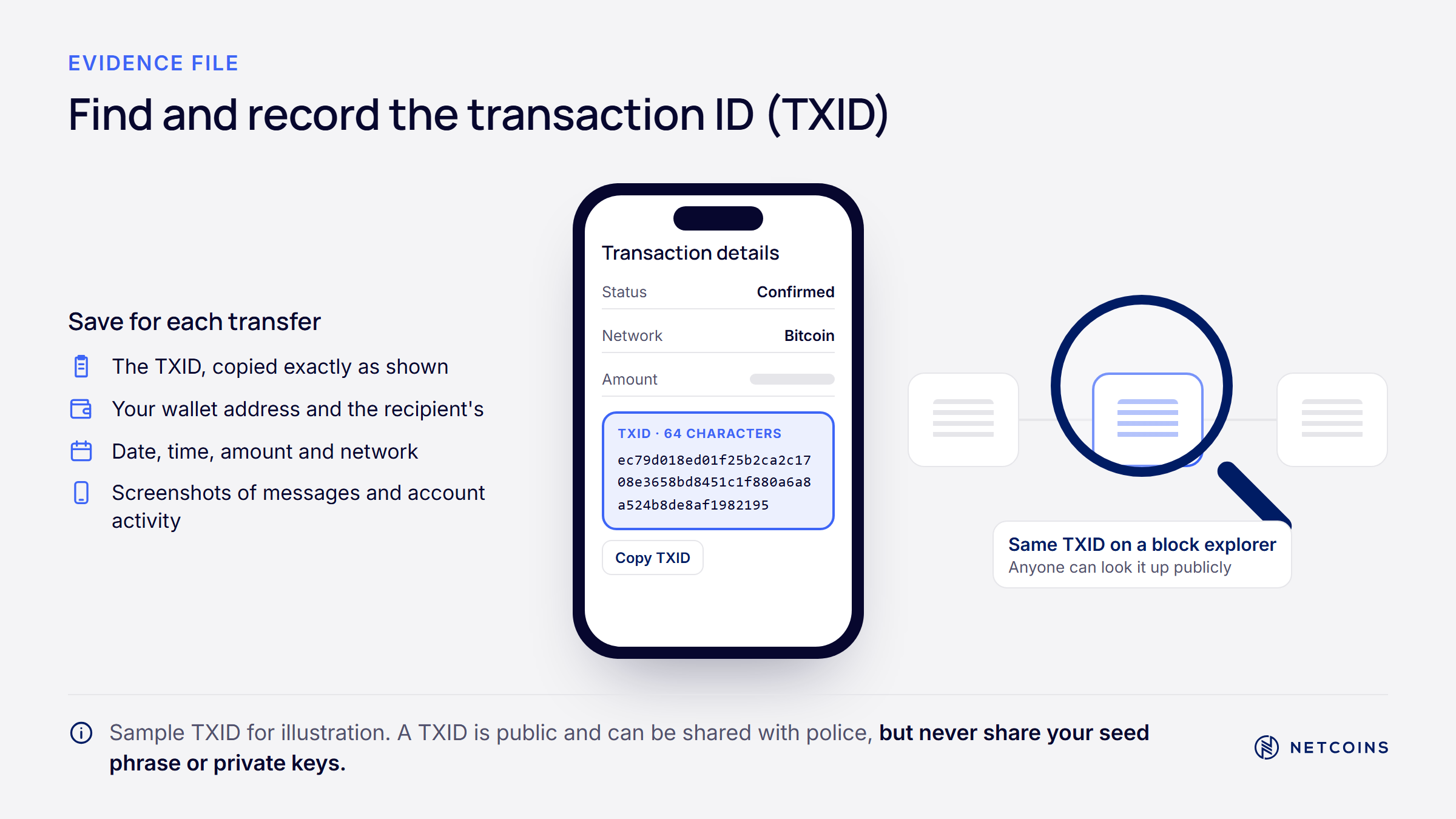
Following asset security, careful collection of digital evidence is essential. The foundational element of a crypto fraud investigation is the Transaction ID (TXID), also known as a transaction hash. A TXID is a unique alphanumeric string, typically 64 characters long, that permanently records the movement of funds on a blockchain [Source]. Investigators use the TXID in blockchain explorers to verify the exact time, amount, and destination address of the fraudulent transfer.
Victims should compile a comprehensive chronological record. This file should contain the TXIDs, the destination wallet addresses, the scammer's contact information, and complete screenshots of all communications [Source]. Printouts or screenshots of the fraudulent websites, terms and conditions, and bank transfer receipts are also useful. If the initial contact occurred via email, the victim should save a copy and note the sender's details. This documentation gives Canadian law enforcement the information it needs to assess the report.
Step 2: Contact the Cryptocurrency Exchange or Platform
The next step is to notify the cryptocurrency platform used to make the transfer. If a victim purchased digital assets on a legitimate platform and then withdrew them to a scammer's external wallet, the transaction is permanently recorded on the blockchain [Source]. Crypto platforms cannot reverse a confirmed blockchain transaction once it leaves their custody.
Even though the transaction cannot be reversed, contacting the platform is still worthwhile. Give the platform's support or compliance team the destination address the scammer used, the TXIDs, and any other details you have. The platform may flag, restrict or take other appropriate action concerning an address or account and may cooperate with law enforcement where legally required. What a platform can do depends on the platform, the facts, applicable law, and its internal controls, so no particular outcome is guaranteed.
User reports also help platforms and investigators identify addresses linked to fraud, which can be useful if funds later move through a platform. Keep a record of your report, including any reference number the platform gives you.
Step 3: Report the Incident to Local Police
The RCMP advises victims of cybercrime and fraud to report to their local police and also to the national reporting system run by the NC3 and the CAFC [Source]. These are two separate reports that work in parallel. You can make them in either order or at the same time, and you do not need a police file number before reporting to the national system.
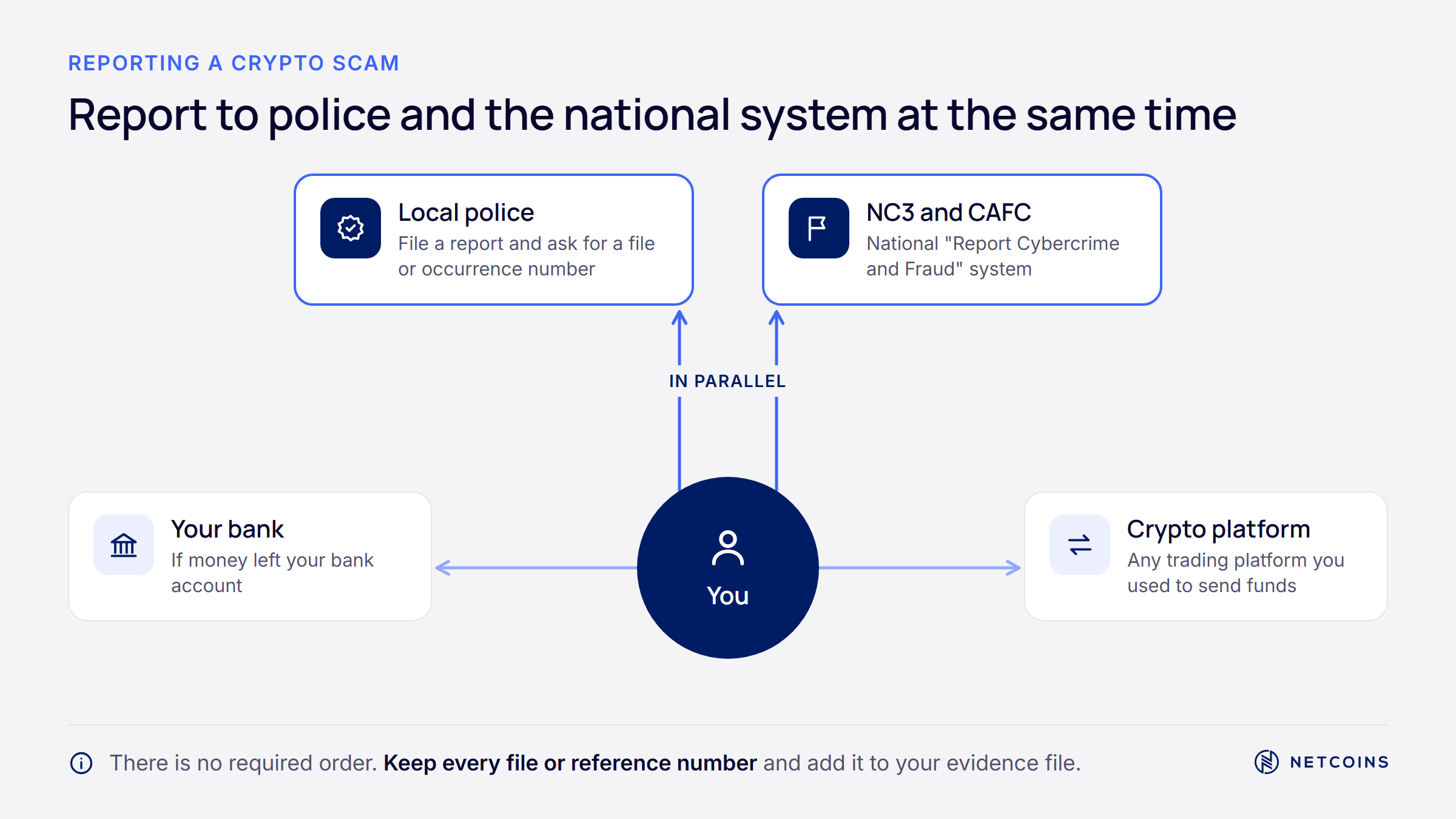
Your local police of jurisdiction could be a municipal service such as the Toronto Police Service or the Vancouver Police Department, or a detachment of the Ontario Provincial Police or the RCMP, depending on where you live [Source]. When you report, police will usually give you a file or occurrence number. Keep it. It can be useful for insurance claims, for your records, and when you follow up with your bank, the platform, or other agencies.
Bring or send the evidence you gathered in Step 1, including TXIDs, communications, and financial records [Source]. A local officer may not have specialized blockchain expertise, but local police can seek support from specialized units, including the NC3, on complex cases.
The NC3 is a unit of the RCMP that coordinates cybercrime intelligence across municipal, provincial, and international boundaries [Source]. Using blockchain analytics tools, the NC3 supports police investigators by tracing the movement of illicit cryptocurrency, identifying patterns across multiple victims, and liaising with international law enforcement when funds cross foreign jurisdictions [Source]. Reports made through the national system are one of the ways this information reaches the NC3.
Step 4: Report to the National Reporting System (CAFC and NC3)
Alongside your local police report, log the incident with the national reporting system operated by the CAFC and the NC3. The CAFC operates as Canada's central repository for information on fraud, identity theft, and cybercrime [Source]. Victims can file a detailed report online through the National Cybercrime and Fraud Reporting System at reportcyberandfraud.canada.ca, or by calling the CAFC toll-free at 1-888-495-8501. The CAFC phone lines operate Monday through Friday from 10:00 am to 4:45 pm Eastern Time [Source]. You do not need a police file number to make this report, though you can include one if you already have it.
Reporting to the CAFC rarely results in immediate or direct asset recovery for the individual victim. Instead, the CAFC processes the submitted TXIDs, fraudulent URLs, and communication logs to identify wider crime trends. This information is shared with the NC3 and partner agencies such as the Competition Bureau of Canada, helping authorities link separate local crimes to organized networks [Source].
The information gathered also supports public awareness efforts. It can help securities regulators issue investor alerts about specific unregistered entities and fake investment platforms [Source]. The Canadian Securities Administrators maintain a national investor alert database to warn the public about illegal activities. By submitting a report, the victim contributes to a national effort to disrupt scammers and prevent future victimization. The CAFC may also guide victims on how to contact credit bureaus like Equifax and TransUnion if identity theft is involved [Source].
Step 5: Notify Financial Institutions and Revoke Approvals
If the scam involved traditional banking, notify your financial institution as soon as possible. This includes cases where the victim sent money to a fraudulent broker by credit card, bank wire, or Interac e-Transfer [Source]. If a transaction is still pending, the bank may be able to stop it.
However, understanding how Interac e-Transfer works for crypto in Canada reveals an important limitation. If the recipient has Autodeposit enabled, the funds are deposited automatically and generally cannot be recalled by the sending bank [Source]. The Interac Zero Liability Policy protects customers from unauthorized access, but it rarely covers fraud where the account holder willingly sent the funds [Source]. Reporting the fraud to your bank can help it watch your accounts more closely for further unauthorized activity [Source].
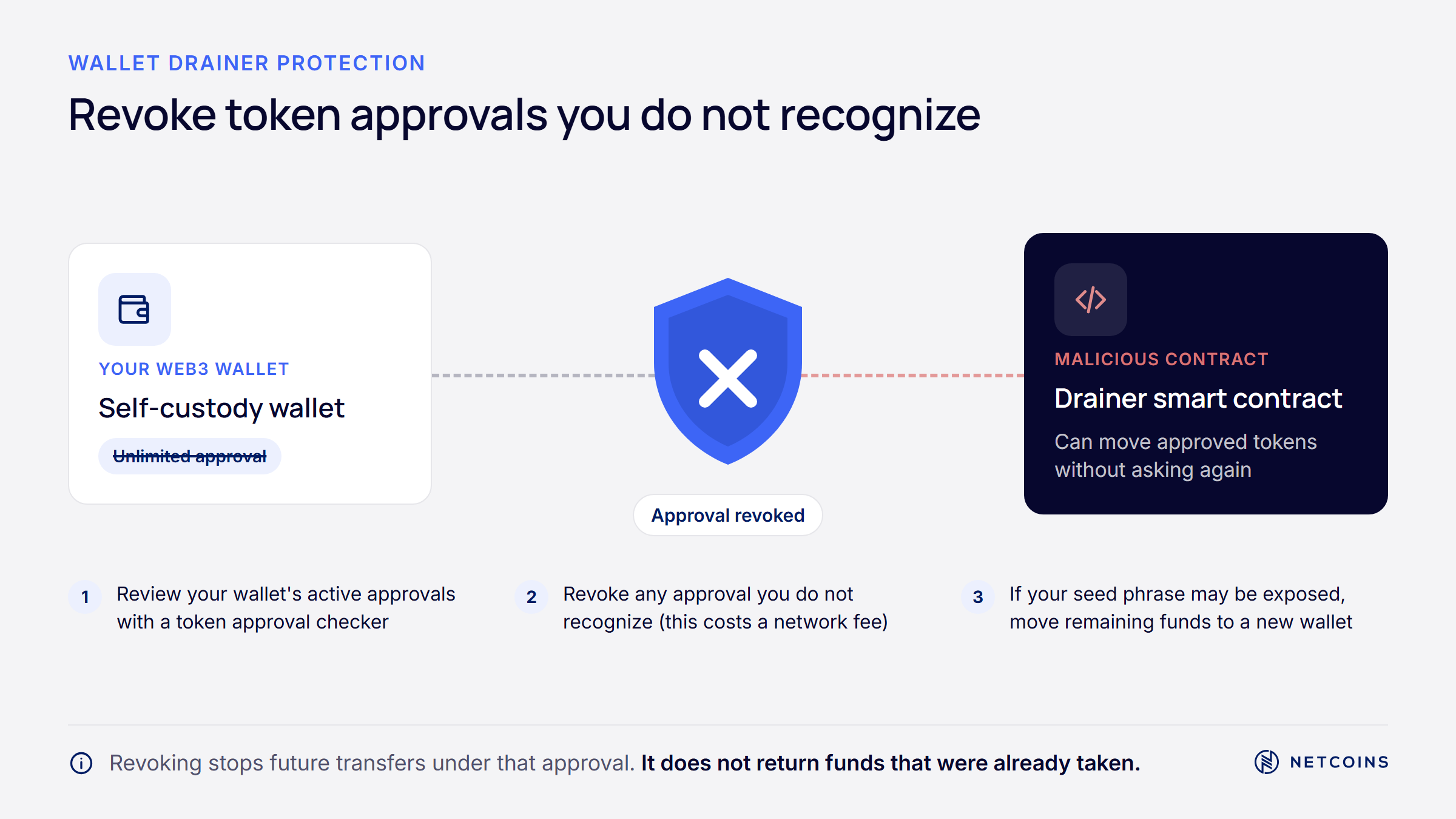
On the cryptocurrency side, victims who used decentralized finance (DeFi) applications should check for risky smart contract permissions. Many modern phishing scams do not steal private keys. Instead, they trick the victim into signing a malicious ERC-20 token approval [Source]. These approvals can grant a third-party smart contract an unlimited right to withdraw tokens from the victim's self-custodial wallet.
Disconnecting the wallet from the fraudulent application is not enough, because the approval stays active on the blockchain. Victims should use a token approval checker, such as a blockchain explorer's approval tool or a dedicated revocation tool, to revoke these permissions [Source]. Failing to revoke a malicious token approval leaves the wallet vulnerable to further draining, even months after the initial incident.
Step 6: Avoiding Secondary Recovery Scams
In the days and weeks following a financial loss, victims are especially vulnerable to recovery scams, sometimes called the double dip. After a victim posts about their stolen cryptocurrency on social media or forums, fraudulent actors make contact. These criminals pose as ethical hackers, blockchain forensic experts, or even fake CAFC or RCMP representatives [Source].
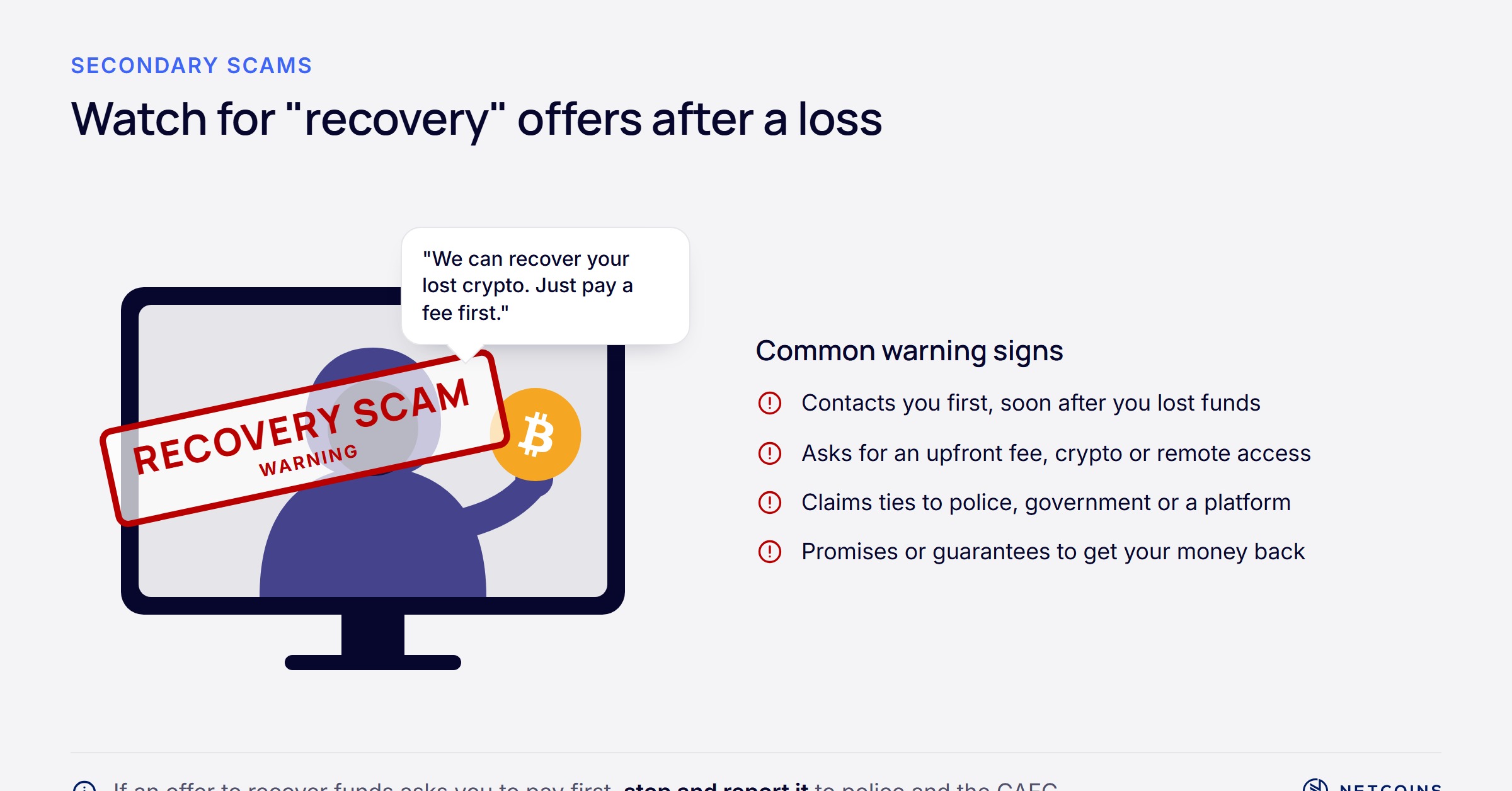
These impersonators claim they have tracked the stolen funds using advanced software. They say they can recover the assets for an upfront service fee, a legal retainer, or a software licensing cost [Source]. Treat any such offer as a scam. Legitimate law enforcement agencies, including the RCMP and the CAFC, will never demand payment in cryptocurrency, wire transfers, or gift cards to conduct an investigation or return stolen funds.
Private blockchain analytics firms also cannot reverse a confirmed transaction. If anyone demands an upfront payment to retrieve lost cryptocurrency, stop all communication. Only contact support teams through the official website or app of the platform you use, never through links or phone numbers sent to you by someone who reached out first.
Step 7: The Role of Blockchain Forensics and the NC3
Understanding the basics of blockchain forensics helps explain how Canadian law enforcement pursues digital asset cases. Cryptocurrency transactions are recorded pseudonymously on public ledgers. To link addresses to real-world actors, specialized investigators use commercial blockchain analytics software that applies data heuristics and machine learning [Source].
A primary technique is the multi-input heuristic. This rule assumes that if multiple distinct addresses are used as inputs in a single transaction, they likely belong to the same controlling entity [Source]. By analyzing unspent transaction outputs in Bitcoin, or account-based transfers in Ethereum, investigators use address clustering to map networks of illicit activity [Source].
The goal of this tracing is to follow the trail through obfuscation techniques such as chain-hopping or mixing services, sometimes until funds reach a centralized platform [Source]. When that happens, law enforcement may be able to seek court orders, such as production orders or warrants, to obtain account information or restrain assets, depending on the facts and the laws that apply [Source]. Recovery is never guaranteed. The NC3 plays a key role by providing Canadian police agencies with cybercrime intelligence, technical capabilities, and specialized skills [Source]. Learning about common Bitcoin scams in Canada is one of the best ways to avoid needing these forensic interventions.
Netcoins is not a law-enforcement agency and cannot investigate, freeze, or recover funds sent to a scammer. The steps above describe the official channels for doing that.
People Also Ask About Reporting Crypto Scams in Canada
Can the RCMP recover stolen cryptocurrency?
The RCMP and other police services can sometimes seize or restrain stolen cryptocurrency, but recovery is never guaranteed. It often depends on whether the funds move to a centralized platform where legal orders can be served, and on the facts and laws that apply. If the funds stay in a wallet controlled only by the scammer, law enforcement generally cannot move them because of how blockchain security works.
How do I report a crypto scam website in Canada?
Report fraudulent crypto websites to the national reporting system run by the CAFC and the NC3. You can also report the malicious URL to the website's hosting provider and domain registrar for a potential takedown, and to your provincial securities regulator, which can add it to investor alert lists.
Can an Interac e-Transfer be reversed if it was a scam?
An Interac e-Transfer generally cannot be reversed once the recipient has deposited the funds. If the scammer uses the Autodeposit feature, the transfer is deposited automatically and is generally considered final, which makes it important to verify a recipient before sending money.
Will my Canadian bank refund me if I was scammed out of crypto?
Canadian banks typically do not refund authorized push payment fraud, which happens when a customer willingly sends money to a scammer. The Interac Zero Liability Policy protects clients against unauthorized access to their accounts, but it rarely covers cases where the account holder authorized the transfer. Contact your bank directly to ask what applies to your situation.
How long does a CAFC fraud investigation take?
The CAFC mainly collects and analyzes fraud reports rather than acting as an investigating police force. Information submitted to the CAFC helps identify national trends, while criminal investigations by the police of jurisdiction or the RCMP can take months to years, depending on the complexity of the case.
Frequently Asked Questions
What is a TXID and why do police need it for a crypto scam report?
A TXID, or transaction hash, is a unique string of characters that permanently identifies a specific transaction on a blockchain. Police need the TXID because it provides verifiable proof of the exact time, date, amount, and destination of the stolen funds, and it is the starting point for blockchain forensic tracing.
How does the National Cybercrime Coordination Centre (NC3) help victims?
The NC3 helps victims indirectly by providing police services with specialized technical expertise and intelligence coordination to investigate cybercrimes. By bringing together reports from across the country, the NC3 identifies large-scale criminal networks and coordinates enforcement actions across jurisdictions.
What are token approvals and how do they cause crypto loss?
Token approvals are smart contract permissions on networks like Ethereum that authorize decentralized applications to access and move tokens within a user's self-custodial wallet. If a user unknowingly grants an unlimited approval to a malicious smart contract, scammers can keep draining the specified tokens from the wallet until the approval is revoked.
Why do recovery scammers target previous victims?
Recovery scammers target previous victims because they are often under stress and eager to get their money back. Fraudsters exploit this by offering false promises of asset recovery in exchange for upfront payments.
Are Canadian cryptocurrency exchanges required to help with fraud investigations?
Crypto trading platforms operating in Canada have anti-money laundering obligations, including registering with FINTRAC as money services businesses. FINTRAC registration is not a licence or an endorsement, and it does not assess a firm's business practices. Like other businesses, platforms may be required to respond to valid legal orders, such as production orders or warrants, from law enforcement. How a platform responds depends on the facts, applicable law, and its internal controls.
Quick Glossary
- CAFC (Canadian Anti-Fraud Centre): The national centre that collects information and intelligence on fraud and identity theft in Canada.
- NC3 (National Cybercrime Coordination Centre): A unit within the RCMP that coordinates cybercrime investigations and provides technical support to Canadian police services.
- TXID (Transaction Hash): A unique alphanumeric identifier generated for every transaction on a blockchain, serving as a permanent receipt of the transfer.
- Blockchain Explorer: A search tool that lets users look up blockchain data for specific addresses, TXIDs, and smart contracts.
- Phishing: A cyberattack where fraudsters impersonate legitimate entities to trick people into revealing sensitive information.
- Token Approval: A permission granted on Web3 networks that allows a specific smart contract to move assets from a user's wallet.
- Pig Butchering: A long-term social engineering scam where a fraudster builds a relationship with a victim before persuading them to deposit funds into a fake investment platform.
- Recovery Scam: Secondary fraud where criminals contact previous scam victims, falsely promising to retrieve stolen cryptocurrency for an upfront fee.
Key Takeaways
- Act immediately to secure assets. If a compromise is detected, reset platform passwords, enable two-factor authentication, and move any remaining funds out of a compromised Web3 wallet.
- Locate the transaction IDs. Gathering the exact blockchain transaction hashes gives police and investigators the starting point they need.
- Report to local police and the national system. These are parallel steps. You do not need a police file number before reporting to the NC3/CAFC national reporting system.
- Revoke malicious approvals. Victims who used decentralized finance applications should revoke risky token permissions to prevent further wallet draining.
- Never pay for recovery services. Upfront fees demanded by anyone claiming they can recover stolen cryptocurrency are a sign of a secondary scam.
Closing
Dealing with the aftermath of a cryptocurrency scam calls for quick documentation and a clear understanding of Canada's reporting channels. By securing accounts, gathering exact TXIDs, and reporting to both local police and the national NC3/CAFC system, victims give authorities the information they need to trace illicit funds and disrupt cybercrime networks. Staying alert and following good security habits is the best ongoing protection. For more on spotting warning signs before money moves, see our guide to common Bitcoin scams in Canada.

About Netcoins
Established in 2014 in Vancouver, British Columbia, Netcoins is a registered Restricted Dealer with the provincial securities commissions and a registered Money Services Business (MSB) with FINTRAC. Netcoins is owned by Surge Digital Inc. (formerly BIGG Digital Assets Inc.), a publicly traded company listed on the TSX Venture Exchange (TSXV: SRGE), and complies with applicable public company regulatory.
The information provided in the blog posts on this platform is for educational purposes only. It is not intended to be financial advice or a recommendation to buy, sell, or hold any cryptocurrency. Always do your own research and consult with a professional financial advisor before making any investment decisions. Cryptocurrency investments carry a high degree of risk, including the risk of total loss. The blog posts on this platform are not investment advice and do not guarantee any returns. Any action you take based on the information on our platform is strictly at your own risk. The content of our blog posts reflects the authors’ opinions based on their personal experiences and research. However, the rapidly changing and volatile nature of the cryptocurrency market means that the information and opinions presented may quickly become outdated or irrelevant. Always verify the current state of the market before making any decisions.
.png)


