


Dollar-cost averaging means buying a fixed dollar amount on a set schedule rather than trying to time entry. Mechanically, the fixed amount buys more units when prices are lower and fewer when prices are higher. Research on traditional markets generally finds lump-sum investing produces higher returns more often, while dollar-cost averaging tends to perform better in the worst downside scenarios. Neither approach prevents losses.
Canadians researching crypto often run into the same question: buy now, or spread purchases out? Dollar-cost averaging is one common answer, and it is frequently described in overly positive terms. This guide covers how it works mechanically, what the research actually found, the situations where it performs worse, and the practical costs of running it with Canadian dollars.
The Core Mechanics of Dollar-Cost Averaging
Dollar-cost averaging works by dividing a total amount of capital into equal instalments and deploying them on a fixed schedule, without reference to price.
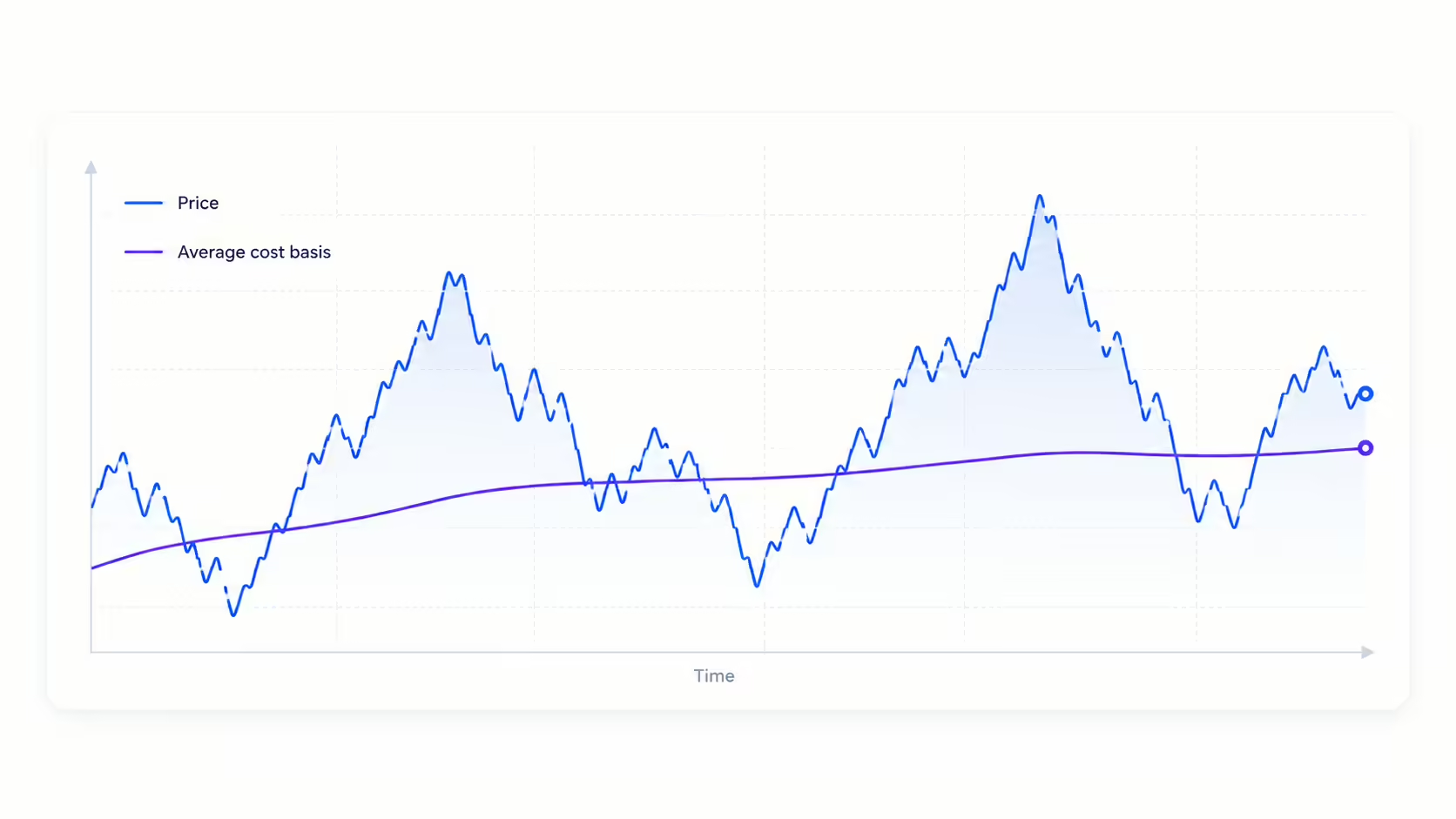
The mechanism is arithmetic rather than predictive. Because the fiat amount stays constant at each interval, a lower price buys more units and a higher price buys fewer. Over multiple purchases, this produces an average cost per unit that sits somewhere between the highest and lowest prices paid. It does not systematically produce a below-market average, and it will not beat a single well-timed purchase.
Crypto assets suit this mechanically because they are divisible to many decimal places, so a fixed Canadian dollar amount can always be allocated precisely. A Canadian committing Can$100 each Monday does not need to assess whether Monday is a good entry point, because the schedule decides for them.
An important clarification: the strategy reduces the influence of any single purchase price on your overall cost basis. It does not reduce the volatility of the asset you hold. Once purchased, the holding fluctuates exactly as much as it would have otherwise. What changes is the risk of committing everything at one price, not the risk of holding a volatile asset.
Bitcoin ownership in Canada sat at around 10 percent of Canadians in 2023, with a median holding worth about Can $500 [Source]. At that scale, transaction costs and spreads matter proportionally more than they would on larger amounts, a point covered later. If you are new to the topic, our guide to cryptocurrency for beginners covers the fundamentals.
Where the Strategy Came From
Dollar-cost averaging originates in traditional equity investing, not crypto, and predates digital assets by decades.
The approach is most closely associated with Benjamin Graham, who discussed it in his 1949 book The Intelligent Investor as a way for ordinary investors to avoid the difficulty of judging market levels. Graham did not invent the underlying idea, which had circulated earlier, but his treatment popularised it. His interest was in removing discretion from the process rather than in improving returns.
For much of the twentieth century the method operated quietly in the background of retirement saving. Regular payroll contributions into mutual funds are dollar-cost averaging by default, since a fixed amount buys whatever the fund unit price happens to be that month. Most people using it were not choosing a strategy so much as following a payroll schedule.
Its application to crypto is more recent and rests on a different argument. Because digital assets can move by double-digit percentages within a single day, some investors apply the method to avoid concentrating a purchase at one price point in a market they consider hard to read.
Worth noting is that the original context differs from the crypto context in a way that matters. Graham was writing about broad equity markets with long histories and underlying corporate earnings. Crypto assets have shorter histories, no cash flows, and different risk characteristics, so conclusions drawn from equity research do not transfer automatically. Familiarity is also uneven: Bank of Canada research found that 40 percent of Bitcoin owners in 2021 showed a low level of knowledge about how Bitcoin works [Source]. Our explainer on what a blockchain is covers what actually underpins these assets.
Dollar-Cost Averaging Versus Lump-Sum Investing
Research on traditional markets generally finds that lump-sum investing produces higher returns more often than dollar-cost averaging, while dollar-cost averaging performs better in the worst scenarios.
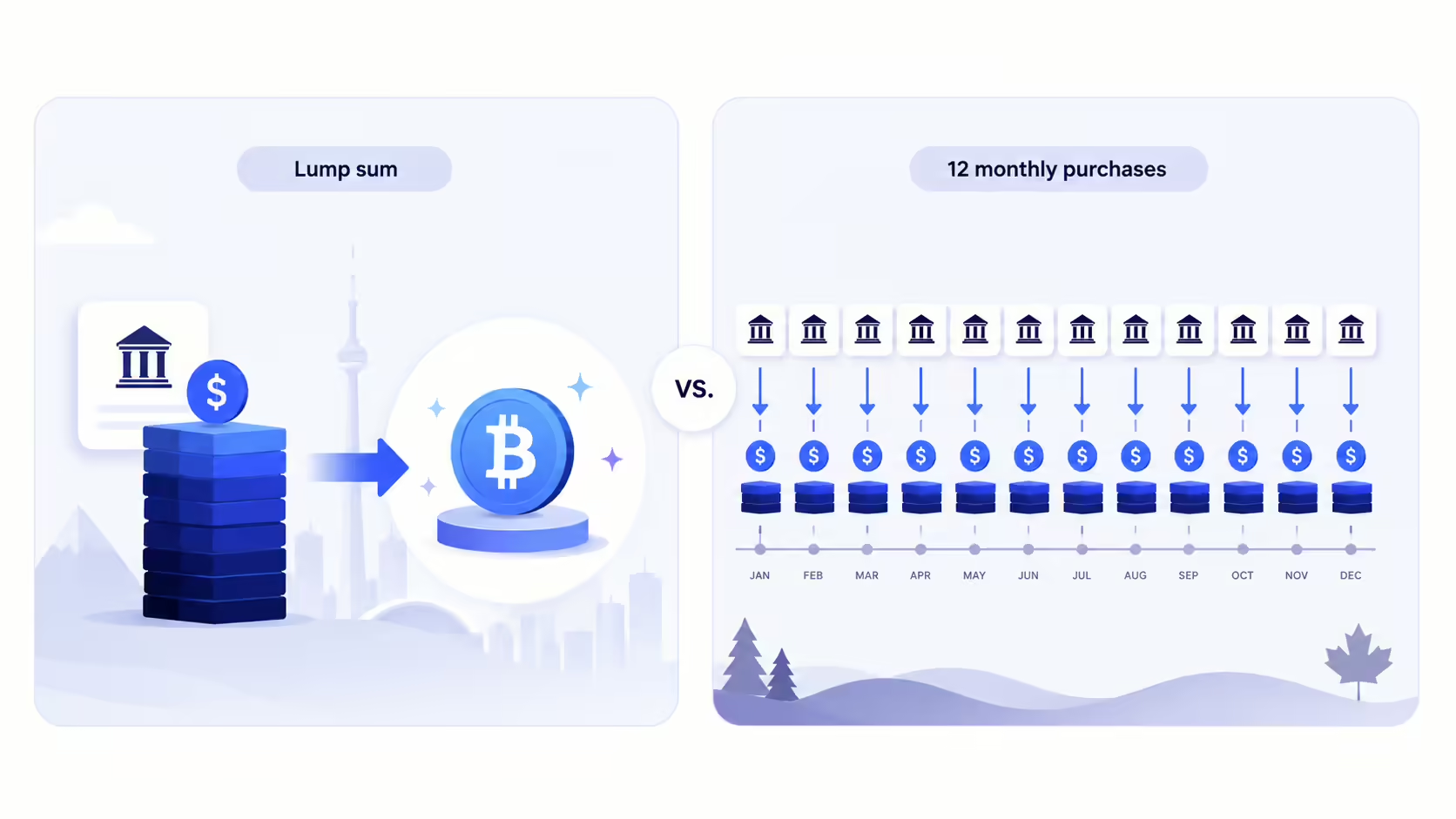
This is the part of the topic most often reported selectively, so it is worth stating plainly. Vanguard research comparing the two approaches across US, UK, and Australian markets found that lump-sum investing beat cost averaging about two-thirds of the time, and that the longer the averaging period, the greater the underperformance relative to investing at once [Source]. Reporting on the same body of research puts the average US performance gap at roughly 2.3 percentage points over the deployment year.
The reason is straightforward arithmetic. Markets have historically risen more often than they have fallen, so capital held in cash awaiting deployment tends to miss growth. Delaying investment means, on average, buying at higher prices later rather than lower ones.
The same research identifies where averaging does better: Vanguard notes that cost averaging outperforms in the very worst downside scenarios, and that the appropriate choice depends on opportunity cost, loss aversion, and investor preference [Source]. That is a genuine trade-off, not a tie-breaker in favour of either method.
Two cautions apply when extending this to crypto. First, the research examined diversified stock and bond portfolios, not single volatile assets, so the win rates should not be assumed to hold. Second, Vanguard itself notes that the appropriate choice depends on opportunity cost, loss aversion, and investor preference, which are individual factors this article cannot assess for anyone. Neither approach removes the possibility of losing money, and a Canadian weighing them may wish to discuss their own circumstances with a qualified, independent financial professional.
Crypto Market Cycles, Volatility, and Investor Behaviour
Crypto markets have historically moved through pronounced cycles, and the size of past declines is the main reason investors think about entry timing at all.
The scale is documented. Glassnode's analysis of the 2021 to 2022 downturn recorded a drawdown of 73.3 percent below the November 2021 all-time high, with a top-to-bottom duration between 227 and 435 days depending on where the decline is measured from [Source]. Earlier cycles were deeper still, bottoming at around 93 percent in 2011 and roughly 84 percent in both 2015 and 2018 [Source].
Those figures deserve to be read carefully. A decline of that magnitude means an investor who committed capital near a peak could have waited well over a year while holding a position worth a fraction of its cost. Past cycles are also not a template for future ones, and there is no basis for assuming any particular pattern repeats.
Behaviour tends to worsen outcomes at both extremes. Loss aversion, where the discomfort of a loss outweighs the satisfaction of an equivalent gain, contributes to selling during declines. Fear of missing out contributes to buying during rapid rises. A fixed schedule removes the decision from those moments, which is the behavioural argument for it.
That argument has a limit worth being honest about. A schedule only helps if it is actually maintained, and evidence from Canadian holders suggests conditions for disciplined investing are not always present: Bank of Canada research found that roughly half of Bitcoin adopters had experienced price crashes, loss of access to funds, scams, or data breaches [Source]. Continuing purchases through a prolonged decline is difficult in practice, and many people stop.
Why Timing the Market Is Difficult
Attempting to identify market tops and bottoms requires interpreting technical data that is demanding even for full-time analysts.
Professional analysts use on-chain metrics derived from blockchain data. One widely referenced measure is the Market Value to Realized Value ratio, which compares an asset's current market capitalisation against its realized capitalisation. Realized capitalisation values each unit at the price it last moved on-chain rather than at the current spot price, producing a rough proxy for the aggregate cost basis of the network [Source].
Others include moving averages, and indicators that track mining economics to identify periods when miners are under financial pressure. Glassnode's own research notes that during the 2022 downturn, spot price fell below realized price, a condition it recorded as having occurred only a handful of times in Bitcoin's history [Source].
Two things should be said about these indicators. They require real familiarity with blockchain data and statistics to interpret, which is why they are mostly used by analysts rather than retail investors. And they are descriptive rather than predictive: they characterise conditions that have occurred, but they do not reliably signal what happens next, and they should not be read as buy or sell triggers.
For a Canadian balancing work and family, monitoring these measures continuously is impractical. A fixed schedule sidesteps the question by not attempting to answer it. That is a reduction in complexity, not an improvement in results, and it means accepting that some purchases will be made at prices that later look poor.
Two Worked Examples in Canadian Dollars
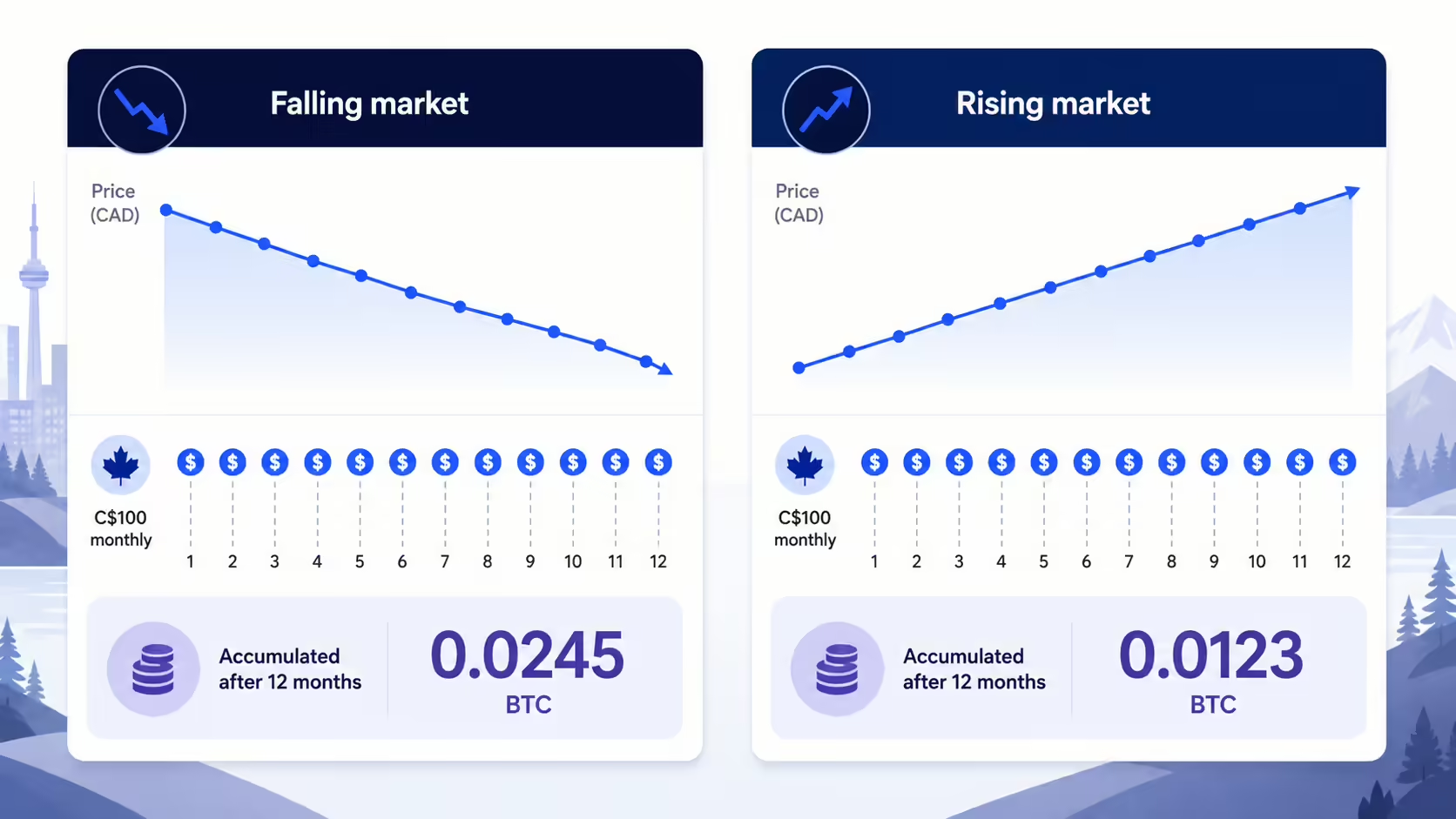
The following are hypothetical examples for illustration only. They use round numbers, are not based on any real asset or time period, and are not projections or indications of future results. A single example proves nothing, so two with opposite outcomes are shown. The Can $100 monthly figure used below is deliberately modest, in line with the Bank of Canada's finding that the median Canadian Bitcoin holding was about Can $500 in 2023 [Source].
Example one: a falling then partially recovering market. An investor commits Can $100 on the first of each month. In month one the price is Can$50, buying 2.0 units. In month two the price falls to Can$25, buying 4.0 units. In month three it settles at Can$40, buying 2.5 units. Total invested is Can$300 for 8.5 units, giving an average cost of about Can$35.29 per unit. A lump sum of Can$300 in month one would have bought 6.0 units at Can $50. Here the scheduled approach ended with more units.
Example two: a steadily rising market. Same Can$100 monthly commitment. Month one price Can$50 buys 2.0 units. Month two rises to Can$75, buying 1.33 units. Month three reaches Can$100, buying 1.0 unit. Total invested is Can$300 for about 4.33 units, an average cost of roughly Can$69 per unit. The lump sum of Can$300 at Can$50 would have bought 6.0 units. Here the scheduled approach ended with substantially fewer.
The comparison between the two examples is the actual lesson. Averaging performs relatively better when prices fall after the first purchase, and relatively worse when prices rise steadily. Which one describes the future is unknowable in advance, which is precisely why the research finds lump-sum investing ahead more often while averaging has historically performed better in the worst declines.
Note also that both examples ignore trading fees and spreads, which depending on the platform may reduce the units acquired and can weigh more heavily on an approach that uses more transactions. Real outcomes will be less favourable than either illustration suggests.
Risks, Limitations, and Costs
Dollar-cost averaging carries specific limitations, and understanding them matters as much as understanding the mechanics.
The clearest limitation is opportunity cost in a rising market, as example two above shows. Capital held back to fund later instalments is not exposed to any appreciation that occurs in the meantime. This is not an edge case, and it is why traditional research finds the approach behind more often than ahead, with Vanguard putting the lump-sum win rate at about two-thirds across the markets it examined [Source].
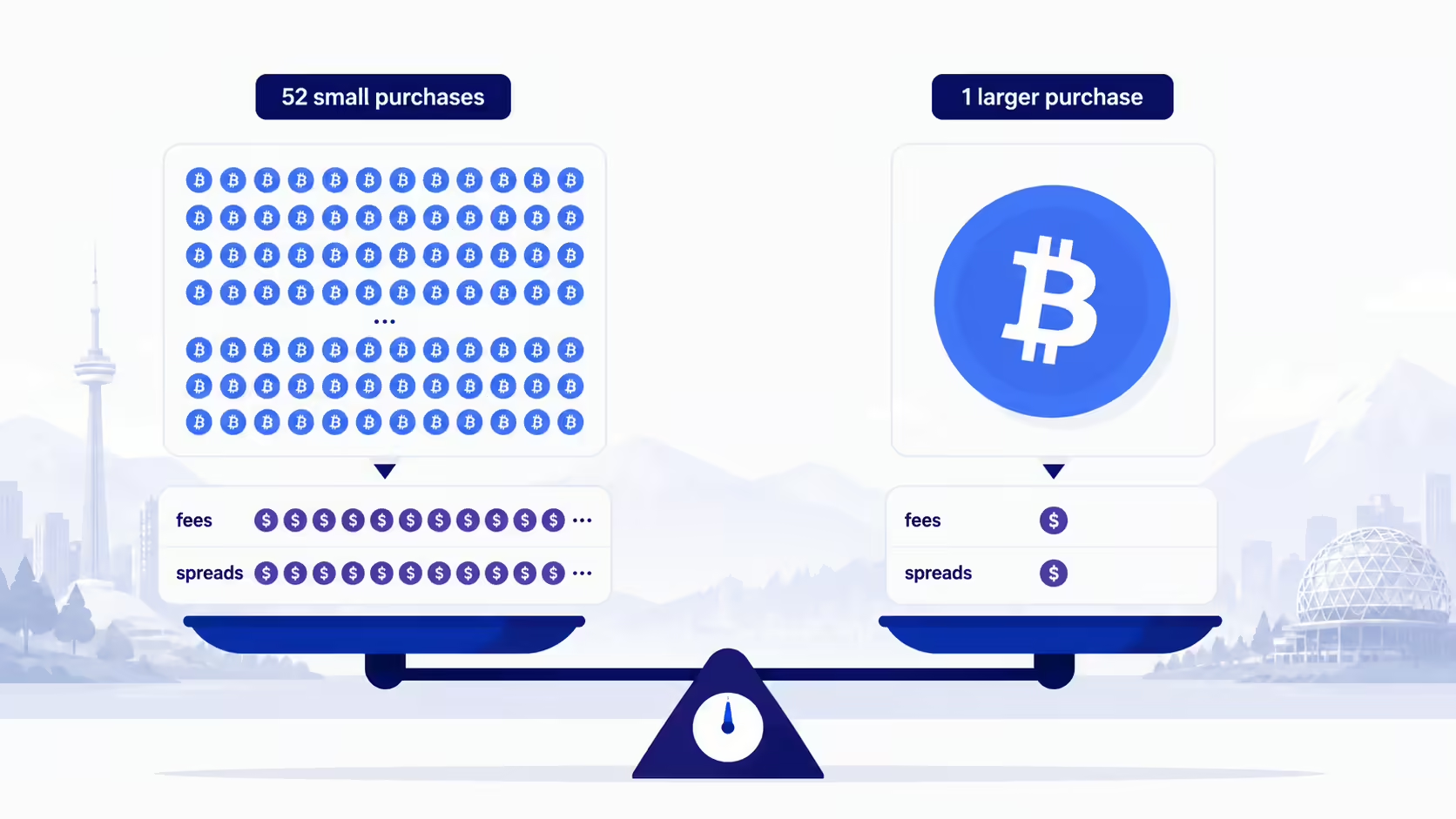
Costs accumulate with frequency. A weekly schedule means roughly 52 transactions a year instead of one, and each may result in additional fees or spreads depending on the platform and the funding method used. Spreads are easy to overlook because they are not itemised as fees. On a Can $100 purchase, a percentage-based cost is small in absolute terms but meaningful relative to the amount. Comparing total cost across platforms is worthwhile, and our comparison of Canadian crypto exchanges covers what to check.
The most significant limitation is that averaging does nothing about asset selection. The method assumes the asset eventually recovers. Buying more of an asset that continues declining indefinitely increases the loss rather than limiting it, and lowering an average cost basis on something that never recovers is not protection. Many crypto assets launched over the past decade have lost most of their value permanently.
Finally, spreading purchases does not address custody or platform risk. Assets held with a platform depend on that company remaining solvent and secure, while self-custody transfers responsibility for keys to you, where loss of a recovery phrase generally means permanent loss. Our overview of crypto custody in Canada covers both, and our guide to common Bitcoin scams in Canada covers a related risk.
Setting Up a Schedule in Canada
Running a schedule in Canada involves deciding on an amount and interval, funding an account, and deciding whether to execute manually or use a platform feature.
Amount and interval come first. A consideration commonly raised is whether an amount is sustainable across a multi-year period, including through a prolonged decline. An amount that feels comfortable during a rising market may not during a drawdown of the size described earlier. How to weigh that against other financial commitments is a personal question, and one a qualified professional is better placed to help with than an article. Weekly, biweekly, and monthly intervals are all common, and aligning with pay periods is a practical choice rather than a mathematically superior one.
Funding is straightforward domestically. Interac e-Transfer is widely familiar, with Bank of Canada survey work finding roughly half of Canadians had used it [Source]. Deposit fees, limits, and processing times vary by platform and change over time, so confirm current details before committing to a schedule. Our guide to how Interac e-Transfer works for crypto in Canada covers the process, and our step-by-step guide to buying Bitcoin in Canada covers the purchase itself.
On execution, some platforms offer recurring purchase features and others require manual orders. Availability differs and changes, so check what a platform currently supports rather than assuming. Automation removes the need to act during volatile periods, which is the main practical argument for it. It also removes a checkpoint, and some people periodically review whether the amount still fits their circumstances.
A closing practical note: platform custody arrangements, supported assets, and fee schedules all change. Whatever schedule you set, reviewing it against current published terms once or twice a year is more reliable than setting it once and assuming the terms hold. For the mechanics of getting started, our complete guide to buying crypto in Canada walks through the process.
People Also Ask About Dollar-Cost Averaging
Does dollar-cost averaging work in crypto? It depends on what "work" means. Mechanically it does what it is designed to do: it spreads purchases across multiple prices so no single entry point determines your cost basis. Whether that produces a better result than investing at once depends entirely on what prices do afterwards, which is unknowable in advance. Research on traditional markets finds lump-sum investing ahead more often, while averaging performs better in the worst declines. Neither prevents losses.
Is it better to buy all at once or dollar-cost average? There is no answer that applies to everyone. Vanguard research found lump-sum investing outperformed roughly two-thirds of the time in traditional markets, while cost averaging did better in the worst downside scenarios. The appropriate choice depends on your own circumstances, including how you would react to a large early loss. That research examined diversified portfolios rather than single volatile assets, so it does not transfer directly to crypto. This is a suitable question for a qualified financial professional.
How often should purchases be made? There is no interval that is mathematically superior. Weekly, biweekly, and monthly are all common, and many people align purchases with pay periods for practical reasons. More frequent purchases mean more transactions and therefore more accumulated fees and spreads, which works against you. Less frequent purchases mean fewer price points and a cost basis more influenced by each one. The trade-off is between transaction cost and price diversification.
Does dollar-cost averaging work in a bear market? When prices are lower, a fixed dollar amount buys more units than the same amount would at a higher price. That is simply how the arithmetic works, and it does not make the approach better or worse than any alternative. Acquiring more units only matters if the asset later rises, which is not assured. Past crypto declines have been severe: Glassnode recorded a 73.3 percent drawdown in 2022 and roughly 84 percent in 2018. Continuing purchases through a decline of that length is difficult, and stopping partway through removes much of the intended effect.
Can dollar-cost averaging result in a loss? Yes. It offers no protection against an asset declining and not recovering. Spreading purchases changes the average price paid, not the direction the asset moves. If the asset falls permanently, additional purchases increase the total loss rather than limiting it. Substantial or complete loss of the amount invested is possible with crypto assets regardless of how purchases are scheduled.
Can Canadian dollars be used for this? Yes. Canadian platforms accept CAD funding through methods including Interac e-Transfer and bank transfers, so purchases can be made directly in Canadian dollars without a currency conversion step. Deposit methods, fees, and limits vary between platforms and change over time. Confirming current terms before setting up a recurring schedule avoids finding that fees or limits differ from what you expected.
Frequently Asked Questions
What happens if a scheduled purchase is missed? A single missed interval within a long schedule has a small effect on the overall average, since the average reflects all purchases made. Some people resume at the next interval, while others adjust the amount instead. Either way, the effect on the overall average is small. Missing purchases repeatedly during a decline has a larger effect, because those are the intervals where the fixed amount would have bought the most units. Consistency matters more than any individual purchase.
Should purchases pause when prices are at record highs? Adherents of the mechanical approach do not pause, since the method is defined by ignoring price. Others reduce or pause allocations at levels they consider high. Both introduce a judgment the schedule was meant to remove, and neither is demonstrably better, since identifying a peak in advance is the problem the schedule exists to avoid. Any decision here is a personal one about your own circumstances.
How much do fees affect the outcome? Enough to matter. Running 52 purchases a year rather than one creates 52 opportunities for costs to apply, and each may result in additional fees or spreads depending on the platform. Spreads are the more commonly overlooked cost because they are not itemised separately. On smaller amounts such as Can$100, percentage-based costs are proportionally more significant, so comparing total cost across platforms is worthwhile.
How is this different from buying the dip? Buying the dip requires judging that a price is temporarily low, which means forming a view on where the market goes next. Dollar-cost averaging deliberately avoids that judgment by purchasing on fixed dates regardless of price. In practice, some people describe themselves as averaging while actually timing purchases around price moves, which reintroduces the discretion the schedule was intended to remove.
Does this strategy suit every investor? No. It suits nobody universally, and no strategy does. It may result in lower returns if prices rise, in exchange for less exposure to committing everything at a single price. Whether that trade-off fits depends on your circumstances, time horizon, and how you would respond to a large decline. Crypto assets are volatile and are not suitable for everyone. An independent, qualified professional can help assess your situation.
Does averaging reduce volatility? No, and this is a common misunderstanding. It reduces the influence of any single purchase price on your average cost. The asset you hold remains exactly as volatile as it was. A position built through 52 purchases fluctuates the same as an identical position built through one, once both are held. The risk that is reduced is entry-point concentration, not market risk.
Quick Glossary
Dollar-Cost Averaging (DCA): Buying a fixed dollar amount of an asset at regular intervals regardless of price, so purchases occur across multiple price points.
Lump-Sum Investing: Deploying all available capital into an asset in a single transaction rather than spreading it over time.
Cost Basis: The average price paid for a holding across all purchases, used as the reference point for measuring gain or loss.
Drawdown: The decline in an asset's price from a previous peak, usually expressed as a percentage.
Spread: The difference between the price quoted to you and the underlying market price. It is a real cost even when not shown as a fee.
Loss Aversion: A documented tendency for the discomfort of a loss to feel stronger than the satisfaction of an equivalent gain, which can prompt selling during declines.
Realized Capitalisation: An on-chain measure valuing each unit of an asset at the price it last moved on the blockchain, used as a proxy for the network's aggregate cost basis.
Opportunity Cost: The return forgone by holding capital in cash rather than investing it, which is the main drawback of spreading purchases in a rising market.
Key Takeaways
- The mechanism is arithmetic, not predictive: a fixed amount buys more units at lower prices and fewer at higher prices, producing an average across the prices paid.
- Research favours lump sum more often: Vanguard found lump-sum investing ahead about two-thirds of the time in traditional markets, while cost averaging did better in the worst declines.
- Outcomes depend on what prices do next: averaging performs relatively better in falling markets and relatively worse in steadily rising ones, and neither case can be known in advance.
- Costs and asset selection matter more than the schedule: more transactions may mean additional fees or spreads depending on the platform, and averaging into an asset that never recovers increases losses rather than limiting them.
- It does not reduce volatility or prevent loss: the asset held remains as volatile as ever, and substantial or complete loss is possible.
Closing
Dollar-cost averaging is best understood as a way of removing a decision rather than a way of improving returns. It replaces a judgment about entry timing with a schedule, which some investors find behaviourally easier to maintain and which carries a measurable cost in rising markets. The Vanguard research referenced above examined traditional stock and bond markets rather than crypto assets. Within that setting it found investing at once ahead more often, and averaging performing better when declines were severe. Because those findings come from traditional markets, they should not be assumed to hold for crypto, which has a shorter history and different risk characteristics. Which consideration matters more depends on circumstances no article can assess for you. Crypto assets are volatile and can lose substantial value regardless of how purchases are scheduled. To continue with the fundamentals, see our overview of cryptocurrency for beginners or our explainer on what a blockchain is.

About Netcoins
Established in 2014 in Vancouver, British Columbia, Netcoins is a registered Restricted Dealer with the provincial securities commissions and a registered Money Services Business (MSB) with FINTRAC. Netcoins is owned by Surge Digital Inc. (formerly BIGG Digital Assets Inc.), a publicly traded company listed on the TSX Venture Exchange (TSXV: SRGE), and complies with applicable public company regulatory.
The information provided in the blog posts on this platform is for educational purposes only. It is not intended to be financial advice or a recommendation to buy, sell, or hold any cryptocurrency. Always do your own research and consult with a professional financial advisor before making any investment decisions. Cryptocurrency investments carry a high degree of risk, including the risk of total loss. The blog posts on this platform are not investment advice and do not guarantee any returns. Any action you take based on the information on our platform is strictly at your own risk. The content of our blog posts reflects the authors’ opinions based on their personal experiences and research. However, the rapidly changing and volatile nature of the cryptocurrency market means that the information and opinions presented may quickly become outdated or irrelevant. Always verify the current state of the market before making any decisions.


