

TL;DR
BNB is the utility token behind an ecosystem of blockchains: the BNB Smart Chain for smart contracts, opBNB for fast, low-cost transactions, and BNB Greenfield for decentralized storage. The network uses ongoing token burns aimed at reducing supply toward 100 million BNB, though burning supply does not guarantee any particular price outcome. Canadians can research the asset through official project documentation and learn how to buy BNB in Canada, but should weigh its concentrated validator structure and general crypto volatility risk before holding it.
BNB has changed a great deal since its 2017 launch, and a lot of older explainers online describe an architecture that no longer exists. This guide explains what BNB actually is today, how its underlying networks work, how its token-burning mechanics function, and what a Canadian researching the asset should understand about its risks before treating any of this as settled ground for a decision.
The Evolution of BNB: From 2017 ICO to Independent Ecosystem
BNB started in 2017 as an Ethereum-based token offering trading fee discounts, and has since moved through several distinct architectures to become the native asset of its own blockchain ecosystem.
The token launched via an initial coin offering in July 2017 as an ERC-20 token on Ethereum, with a hard cap of 200 million tokens set at creation [Source]. The original use case was straightforward: holders received a discount on trading fees on the Binance exchange, an incentive that started high and was reduced over subsequent years.
By April 2019, the project launched its own blockchain, originally called Binance Chain, optimized for fast trading rather than general-purpose smart contracts. Because that chain deliberately excluded smart contract functionality to maximize speed, a second chain, the BNB Smart Chain (BSC), launched in September 2020 to support decentralized applications, running in parallel to the original chain, which was later renamed the BNB Beacon Chain [Source].
Running two separate chains connected by a bridge introduced complexity and, since cross-chain bridges are a common target for exploits, additional security exposure. In 2024, the project completed what it called "Chain Fusion," permanently retiring the Beacon Chain and migrating all staking and governance functions onto the BNB Smart Chain [Source]. The ecosystem has operated on a single-chain governance model since that migration completed.
Understanding this kind of architectural history matters when researching any blockchain project, since documentation and third-party explainers can describe outdated versions of a network. For general background on how blockchains work, see our explainer on what a blockchain is, and for the fundamentals of acquiring a digital asset in Canada in the first place, our complete guide to buying Bitcoin in Canada is a useful starting point.
Understanding the BNB Chain Architecture
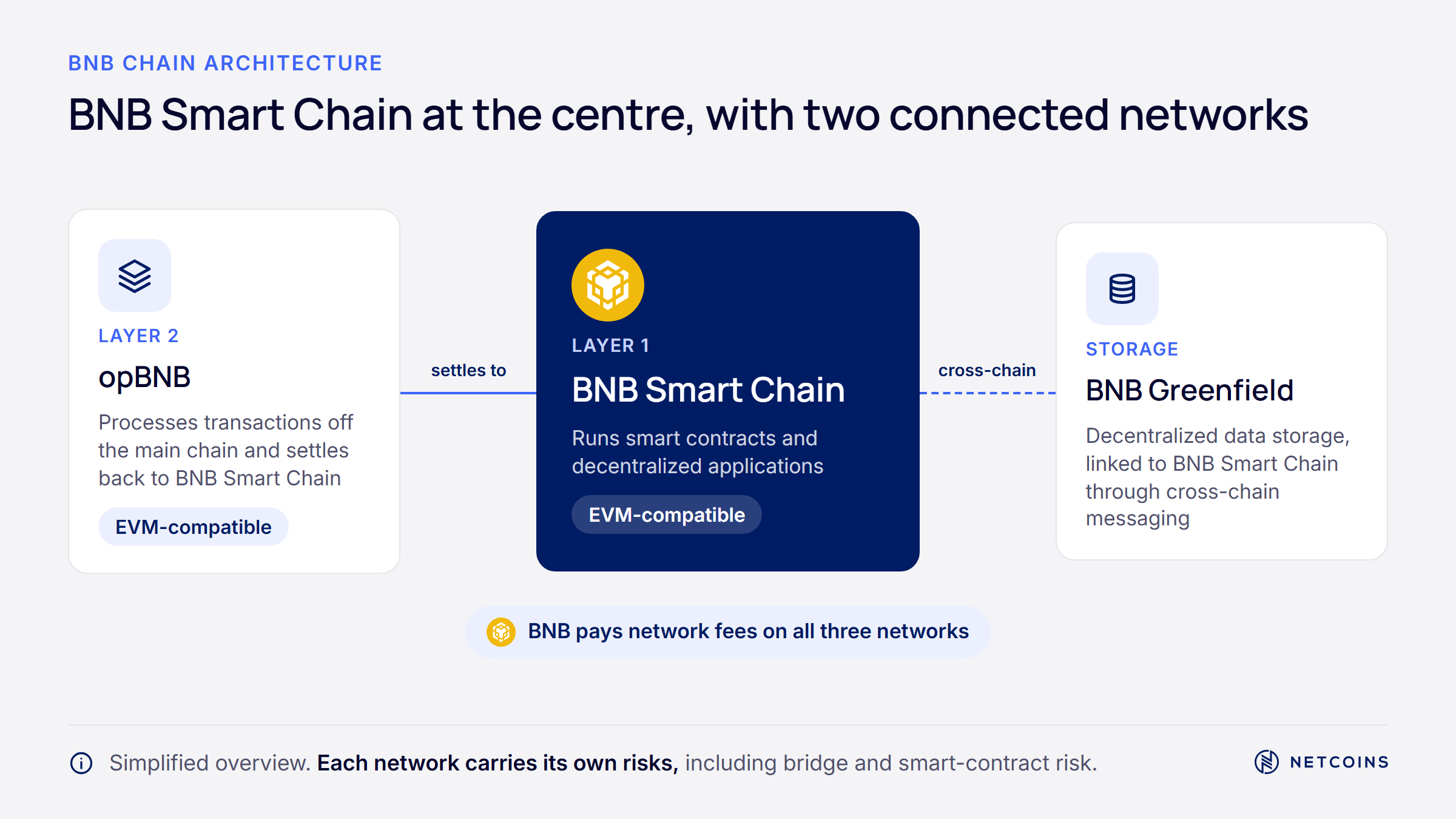
Today's BNB Chain ecosystem consists of three separate but connected networks: the BNB Smart Chain for smart contracts, opBNB for scaling, and BNB Greenfield for decentralized data storage.
The BNB Smart Chain (BSC) is the foundational layer. It is compatible with the Ethereum Virtual Machine, meaning it can run smart contracts written in Solidity, the same programming language used on Ethereum, which lets developers deploy Ethereum-based applications on BSC with limited changes [Source]. This compatibility is a major reason the network attracted a large number of decentralized finance applications.
Tokens created on BSC follow the BEP-20 standard, a close counterpart to Ethereum's ERC-20 standard. Every transaction or smart contract interaction on the network requires a small fee, paid in BNB, commonly called gas [Source].
The three main layers differ in purpose:
- BNB Smart Chain: the core layer for smart contracts, decentralized finance applications, and general transactions, using the BEP-20 token standard.
- opBNB: a Layer 2 scaling network built for high transaction volume at very low cost, connected to BSC via bridging.
- BNB Greenfield: a decentralized data storage network that links stored data to ownership records on BSC through non-fungible tokens.
Holders can also stake BNB with validators to help secure the network, earning a share of the transaction fees the network generates in return [Source]. Comparing this design to other major smart-contract networks can help put it in context; see our guide to Bitcoin versus Ethereum for the fundamentals of proof-of-work and proof-of-stake systems.
Proof of Staked Authority: How the Network Reaches Consensus
The BNB Smart Chain confirms transactions using Proof of Staked Authority, a consensus model that combines elements of staking with a fixed, elected set of validators rather than open, competitive mining.
Unlike Bitcoin's energy-intensive mining or Ethereum's broadly distributed staking, Proof of Staked Authority narrows participation to a defined validator set to prioritize speed. Each day at 00:00 UTC, the network elects its top 45 validators by the amount of BNB delegated to them. Of these, the 21 with the highest stake are called Cabinets and the remaining 24 are called Candidates. Each block-production cycle draws 18 validators from the Cabinets and 3 from the Candidates to form the working consensus group [Source].
Because this consensus group is small and coordinated, the network can produce blocks very quickly. BNB Chain has shortened the BSC block interval through several upgrades, most recently the Fermi hard fork, which activated on mainnet in January 2026 and brought block times to well under one second [Source]. Block times can change again with future upgrades, so check the current figure in the BNB Chain documentation rather than relying on any fixed number. That speed and a small, fixed validator set are directly related: a smaller group can agree faster, but it also concentrates network security among fewer parties than a broadly distributed validator set would.
Validators who misbehave face slashing penalties. Signing conflicting blocks results in a 200 BNB penalty and a 30-day suspension, and missing more than 150 blocks in 24 hours results in a smaller penalty and a two-day suspension [Source]. Anyone can also delegate BNB to a validator without running one themselves, earning a share of rewards, though delegated funds are locked and earn nothing for seven days after being withdrawn.
The Deflationary Mechanics: Auto-Burn and BEP-95
BNB's supply is reduced over time through two mechanisms, a quarterly Auto-Burn and a continuous BEP-95 gas fee burn, both aimed at a long-term target of 100 million tokens, though reducing supply does not by itself guarantee any particular price outcome.
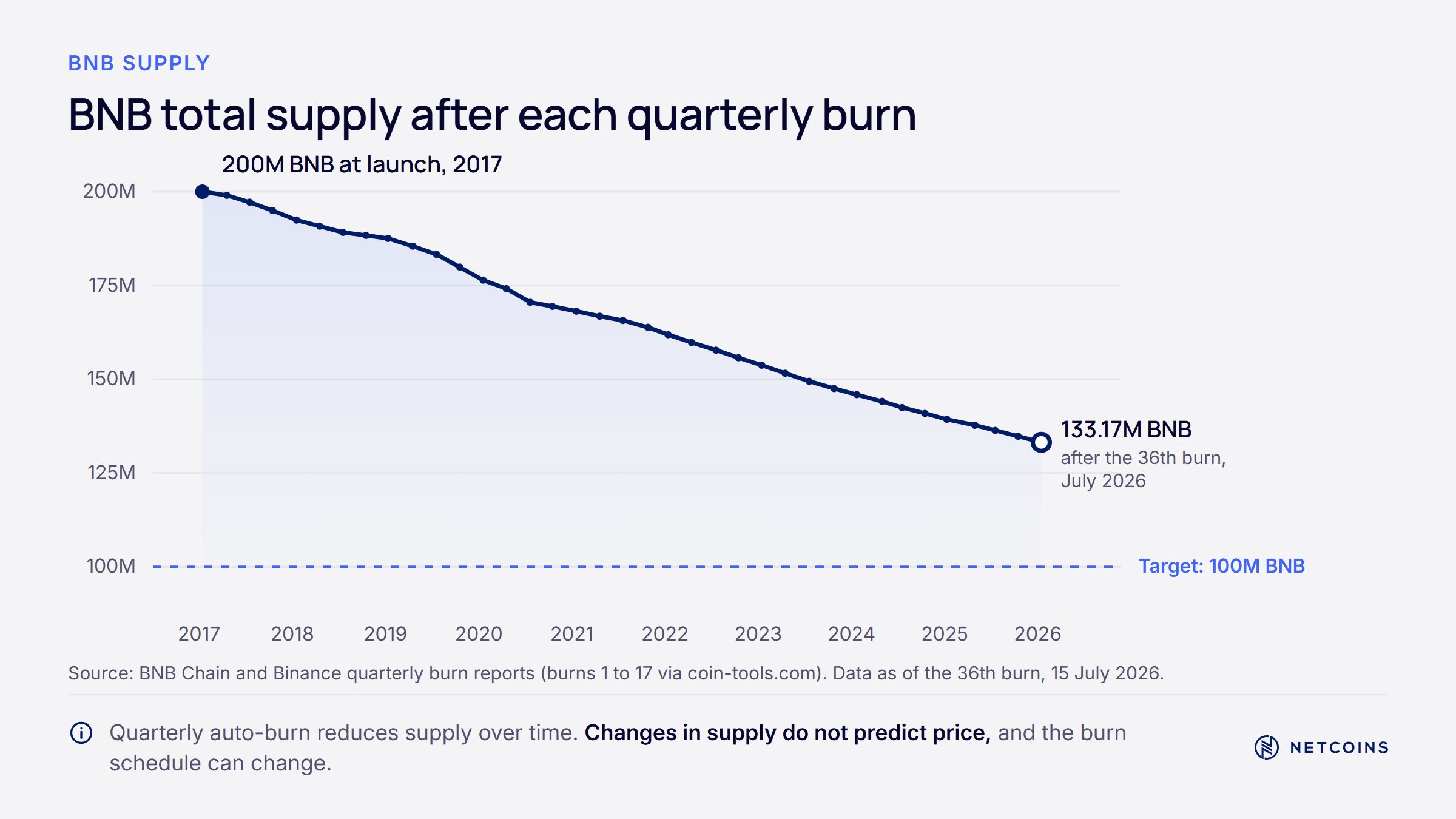
A token burn sends tokens to an address with no known private key, permanently removing them from circulation. The Auto-Burn runs every quarter and calculates the amount to burn using a formula based on BNB's price and the number of blocks produced on BSC during that quarter, replacing an earlier process that was tied to a percentage of the exchange's reported profits. The most recent quarterly burn at the time of writing, the 36th, was completed on July 15, 2026. It removed about 1.62 million BNB and left a total supply of approximately 133.17 million BNB, down from the original 200 million cap [Source]. Because burns happen every quarter, this figure will keep changing, so check the BNB Chain blog and its linked real-time data for the latest total.
BNB Chain has also noted that, after recent network upgrades, BSC produces blocks more frequently than it did when the Auto-Burn formula was first defined [Source]. Since block count is one of the formula's inputs, that is one more reason not to project future burn amounts from past ones.
BEP-95, introduced in 2021, burns a set percentage of gas fees in real time, block by block, rather than in a single quarterly event. The burn ratio was initially set at 10 percent and is adjustable through validator governance [Source].
It is worth being direct about what this does and does not mean. Reducing supply changes the mechanics of the asset, but it does not create demand, and demand is what actually determines price. An asset can have a shrinking supply and still decline in value if fewer people want to hold it. Investors should treat deflationary tokenomics as a design feature to understand, not as an assurance of future value.
Expanding the Ecosystem: opBNB and BNB Greenfield
BNB Chain expanded beyond its core smart contract layer with opBNB, a Layer 2 network for high-volume transactions, and BNB Greenfield, a decentralized storage network.
opBNB is built using the Optimism OP Stack as an optimistic rollup, meaning it processes large batches of transactions off the main chain and assumes they are valid unless challenged, only running a verification process if a transaction is disputed [Source]. This design allows very short, sub-second block times, which have been shortened further through network upgrades, most recently in January 2026 [Source], and fees that are commonly a small fraction of a cent [Source]. That matters for use cases like gaming or high-frequency micro-transactions, where a proportionally larger network fee would make small payments impractical. As with BSC, check the current opBNB documentation for up-to-date performance figures.
BNB Greenfield addresses a different problem: decentralized data storage. Rather than relying on a single centralized server, data on Greenfield is encrypted, split into pieces, and distributed across a network of independent storage providers, who must meet minimum bandwidth and uptime requirements or face penalties [Source]. When a user stores data, the network generates a linked token on BSC, letting the user manage access permissions through smart contracts rather than a centralized account system [Source].
Both networks depend on BNB for fees, which is part of why the asset's utility is described as extending beyond simple transaction costs on the main chain. Whether these secondary networks achieve meaningful independent adoption over time is a separate question from how they are designed to work, and it is worth researching current usage rather than assuming design intent equals real-world traction.
Centralization, MEV, and Structural Trade-Offs
BNB Chain trades some of the broad decentralization found in networks like Bitcoin or Ethereum for speed, and this trade-off shows up clearly in how block production and transaction ordering work.
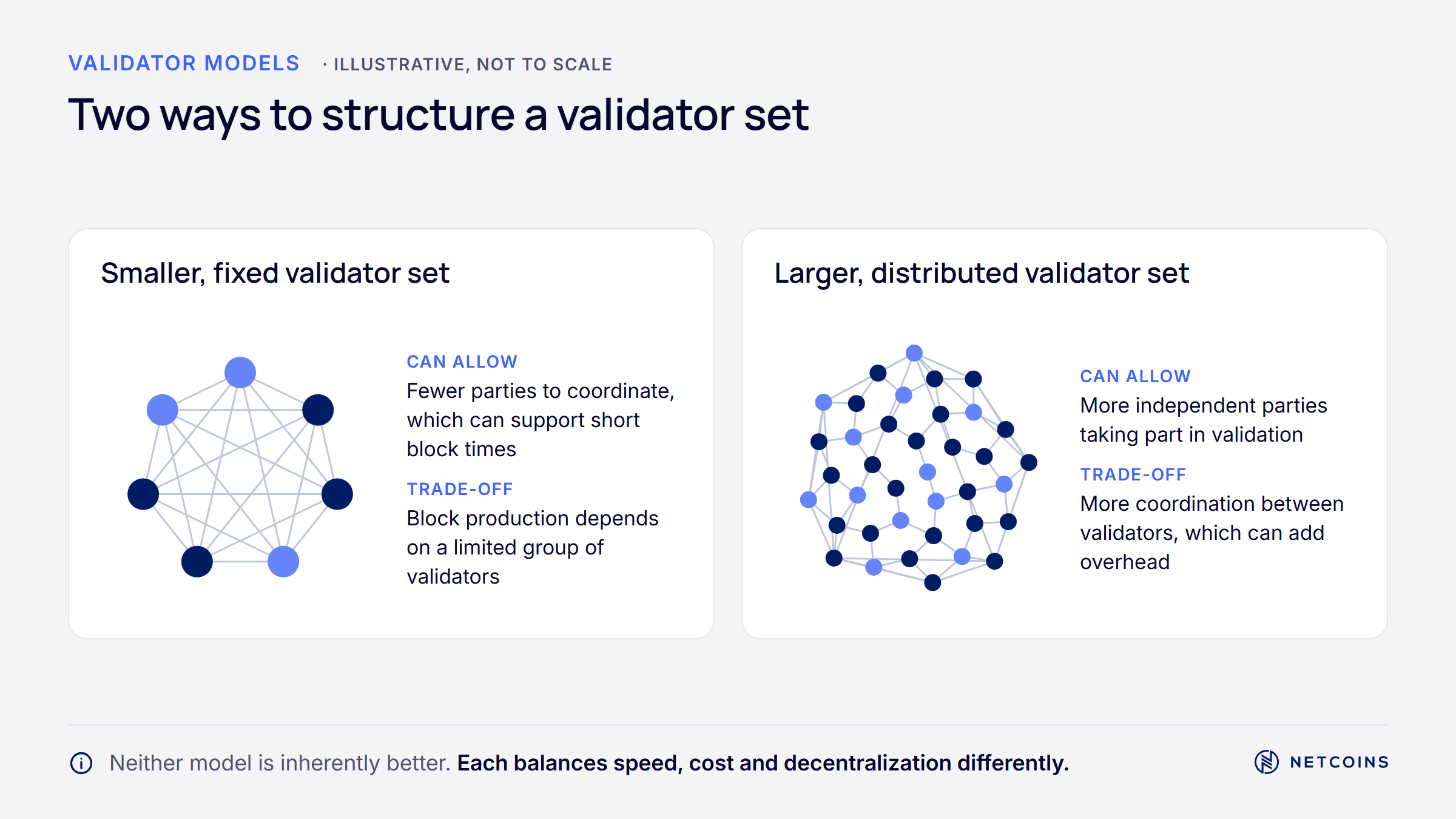
Because only 45 validators are ever active at a time [Source], and entities connected to the exchange that created the network have historically represented a meaningful share of staked BNB, the network is more centralized by design than networks with hundreds or thousands of independent validators. That is not necessarily a flaw for every use case, since it is precisely what allows fast, cheap transactions, but it is a genuine structural difference worth understanding rather than glossing over.
A related issue is Maximal Extractable Value, or MEV, where whoever controls block production can potentially profit by reordering or inserting transactions, for example by front-running a trade. This is not unique to BNB Chain; it is a known consideration across most blockchains that rely on a proposer to order transactions within a block. Networks address it differently, and the specifics of how any given network structures block-building and how open or restricted that process is are worth researching directly through current project documentation, since implementations change and third-party technical analyses can go out of date.
For a Canadian researching this ecosystem, the practical takeaway is that speed and low fees are real, measurable properties of the network, and they come from specific design choices that concentrate certain functions among fewer participants than some competing networks. Both things can be true at once, and evaluating the trade-off is a matter of individual judgment rather than a simple better-or-worse comparison.
Risks and Things to Understand Before Holding BNB
BNB carries the general risks common to crypto assets, plus some considerations specific to its more centralized architecture and its close association with a single exchange ecosystem.
Price volatility is the most direct risk. BNB, like other crypto assets, can experience large price swings in short periods, and past price behaviour does not predict future results. Bank of Canada research on Bitcoin owners, whose experiences broadly reflect risks common across crypto assets, found that about half had experienced price crashes, loss of access to funds, scams, or data breaches [Source]. Deflationary supply mechanics, discussed earlier, do not offset this. A shrinking token supply is a mechanical fact about the asset, not a guarantee that demand, and therefore price, will hold or rise.
Concentration is a second consideration. A validator set capped at 45, with a meaningful share of staking power historically tied to entities connected to the exchange that created the network, means governance and network security depend on fewer independent parties than on more broadly distributed networks. This can affect how resilient the network is to a small number of participants acting in coordination, and it is a reasonable factor to weigh against the practical benefits of speed and low fees.
Operational risks apply as they do to any crypto asset: transactions on BSC, opBNB, and Greenfield are irreversible once confirmed, so sending funds to an incorrect address or the wrong network generally results in permanent loss. Scams targeting crypto holders, including fake wallet apps and phishing attempts, are a persistent threat across all networks, not just this one. Our guide to common Bitcoin scams in Canada covers tactics that apply broadly to crypto holders.
None of this is a reason to avoid researching the network, and understanding how something works is different from deciding whether to hold it. It does mean that claims framing BNB's burn mechanics as a straightforward path to higher value deserve real scrutiny, since they describe only one side of what determines an asset's price.
Funding and Storing Digital Assets in Canada
Canadians researching digital assets generally use Canadian crypto trading platforms to fund accounts in Canadian dollars, acquire assets, and choose between platform custody or self-custody afterward. Before using any platform, check whether it is registered with the applicable Canadian securities regulators, and review its custody, fee, and risk disclosures.
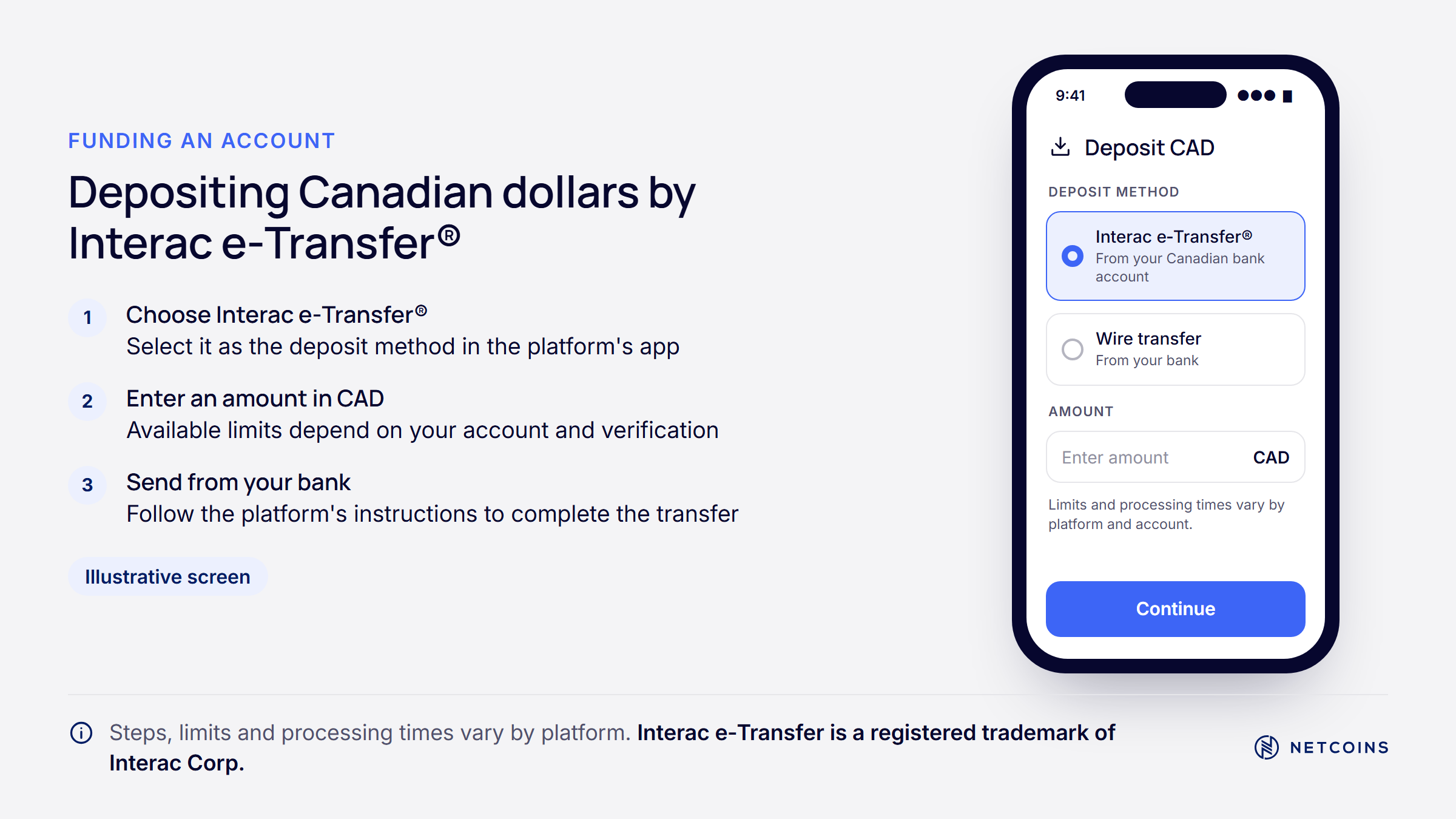
Canadian crypto trading platforms typically support funding through Interac e-Transfer, which is familiar to most Canadians, and wire transfers for larger amounts. Bank of Canada survey work found that roughly half of Canadians had used Interac e-Transfer [Source]. Processing times, limits, and fees vary by platform and change over time, so confirming current details directly is more reliable than relying on a fixed figure. Our guide to how Interac e-Transfer works for crypto in Canada covers the mechanics.
Once an account is funded, acquiring a digital asset generally follows a standard process: verify identity, fund the account, and place a trade. Our step-by-step guide to buying Bitcoin in Canada covers this process in detail, and the same general steps apply across most digital assets available on a given platform.
After acquiring an asset, a choice remains between leaving it with a platform or moving it to a personal wallet. Platforms use different custody arrangements, which may include third-party custody providers and keeping some keys offline in cold storage. These arrangements differ between platforms and change over time, and no custody model removes all risk. Self-custody gives you more direct control but shifts full responsibility for securing private keys to the individual, where a lost recovery phrase generally means permanently lost funds. Our overview of crypto custody in Canada covers this trade-off in more depth, and for those interested in how staking works on other networks, our guide to crypto staking explains the mechanics and risks involved.
People Also Ask About BNB Coin
Is BNB an ERC-20 token?
BNB started as an ERC-20 token on Ethereum when it launched in 2017, but it no longer operates on that standard. In 2019, it moved to its own blockchain infrastructure, and it now functions as a BEP-20 token native to the BNB Smart Chain. The original ERC-20 tokens were swapped for tokens on the new network during that migration, so any older reference to BNB as an Ethereum-based asset describes a structure that no longer applies.
What is the difference between Binance Chain and BNB Smart Chain?
The original Binance Chain, later renamed the BNB Beacon Chain, was built for fast trading and governance but deliberately excluded smart contract capability. The BNB Smart Chain launched afterward specifically to support smart contracts and decentralized applications. In 2024, the project retired the Beacon Chain entirely and consolidated all staking and governance functions onto the BNB Smart Chain, so the two-chain structure some older content describes no longer exists.
Does BNB have a maximum supply?
BNB's original hard cap was set at 200 million tokens when it launched in 2017. Since then, ongoing quarterly and real-time burns have reduced the supply, with a long-term target of 100 million tokens. After the 36th quarterly burn on July 15, 2026, total supply stood at approximately 133.17 million BNB [Source]. This figure changes every quarter, so check the BNB Chain blog for the latest number. Reaching the 100 million target depends on the pace of future burns, which are tied to price and network activity rather than fixed on a set schedule.
What is opBNB used for?
opBNB is a Layer 2 network designed to process transactions faster and at lower cost than the main BNB Smart Chain, using optimistic rollup technology that batches transactions off-chain before posting a summary back to the main network. It is aimed at use cases involving high transaction volume and low per-transaction value, such as gaming or frequent micro-transactions, where paying a proportionally large network fee on the main chain would be impractical.
How does the BNB Auto-Burn work?
The Auto-Burn is a quarterly mechanism that calculates how many tokens to permanently remove from circulation based on a formula combining BNB's price and the number of blocks produced on BSC during that quarter. It replaced an earlier process tied to a share of the exchange's reported trading profits, moving the calculation to on-chain, verifiable data instead. The burn amount varies each quarter depending on those two inputs, and recent upgrades that increased block frequency have affected the block-count input.
Frequently Asked Questions
What consensus mechanism does the BNB Smart Chain use?
It uses Proof of Staked Authority, which elects a fixed set of 45 validators daily based on how much BNB is staked to them, rather than relying on open competitive mining or a much larger distributed validator pool. This design prioritizes transaction speed and low fees, and after a series of network upgrades the chain produces new blocks in well under one second. It does so by concentrating block production among a smaller, defined group than some competing networks use.
What is the BEP-20 token standard?
BEP-20 is the technical format used to create tokens on the BNB Smart Chain. It closely mirrors Ethereum's ERC-20 standard because the network is compatible with the Ethereum Virtual Machine, which lets developers adapt Ethereum-based projects for the BNB Smart Chain without extensive changes to their underlying code.
Can users store data on the BNB network?
Yes, through BNB Greenfield, a separate network built specifically for decentralized data storage. Data is encrypted and distributed across independent storage providers rather than held on a single centralized server, and a linked token on the BNB Smart Chain lets users manage who can access their stored data through smart contracts.
How long does a BSC transaction take to process?
Following a series of network upgrades, most recently the Fermi hard fork in January 2026, the BNB Smart Chain produces new blocks in well under one second. Block times can change with future upgrades, so the official BNB Chain documentation is the best place to check the current figure. Actual transaction confirmation can vary depending on network conditions and on how many confirmations, or which finality rule, a specific application or platform requires before treating a transaction as final.
What was Chain Fusion?
Chain Fusion was a 2024 upgrade that permanently retired the original BNB Beacon Chain and moved all staking, governance, and core network functions onto the BNB Smart Chain. The change was intended to remove the security risk associated with the cross-chain bridge that previously connected the two networks, since bridges between blockchains have historically been a common target for exploits across the industry.
Quick Glossary
- BEP-20: The technical standard for creating tokens on the BNB Smart Chain, closely modeled on Ethereum's ERC-20 standard.
- EVM Compatibility: The ability of a blockchain to run code written for the Ethereum Virtual Machine, letting developers port Ethereum-based projects to that network.
- Layer 2: A network built on top of a main blockchain to process transactions faster and more cheaply, later settling a summary back to the main chain.
- Maximal Extractable Value (MEV): Extra profit a validator or block builder can potentially capture by reordering, inserting, or excluding transactions within a block.
- opBNB: A Layer 2 scaling network for the BNB ecosystem, built to handle high transaction volume at very low cost.
- Proof of Staked Authority (PoSA): A consensus method that elects a fixed, limited set of validators based on staked amounts, rather than relying on open mining or a much larger validator pool.
- Token Burn: Permanently removing tokens from circulation by sending them to an address with no accessible private key.
- Validator: A network participant responsible for verifying transactions and proposing new blocks in exchange for staking rewards.
Key Takeaways
- BNB's architecture has changed substantially since 2017: it moved from an Ethereum-based token to its own blockchain, and the 2024 Chain Fusion retired the original Beacon Chain entirely, so older explainers describing a two-chain structure are outdated.
- The ecosystem now spans three networks: the BNB Smart Chain for smart contracts, opBNB for fast low-cost transactions, and BNB Greenfield for decentralized storage.
- Deflationary burns reduce supply but do not guarantee value: the Auto-Burn and BEP-95 mechanisms have brought total supply down toward a 100 million target, but reduced supply does not create demand.
- Speed comes from a trade-off: a fixed set of 45 validators enables fast, cheap transactions but concentrates network security among fewer participants than more broadly distributed networks.
- BNB carries real risk: it is volatile, transactions are irreversible, and its more centralized structure is a factor worth weighing alongside its practical advantages.
Closing
BNB's history is a useful case study in how quickly blockchain infrastructure can change, and how much outdated information circulates as a result. Understanding the current architecture, the mechanics behind its token burns, and the trade-offs built into its consensus design gives a clearer picture than either uncritical promotion or a shallow summary would. None of that changes the fact that BNB is a volatile asset whose price depends on demand that no mechanism can guarantee. For Canadians continuing their research, our overview of cryptocurrency for beginners and our explainer on how Bitcoin mining works are useful next steps for understanding how different blockchain consensus models compare.

About Netcoins
Established in 2014 in Vancouver, British Columbia, Netcoins is a registered Restricted Dealer with the provincial securities commissions and a registered Money Services Business (MSB) with FINTRAC. Netcoins is owned by Surge Digital Inc. (formerly BIGG Digital Assets Inc.), a publicly traded company listed on the TSX Venture Exchange (TSXV: SRGE), and complies with applicable public company regulatory.
The information provided in the blog posts on this platform is for educational purposes only. It is not intended to be financial advice or a recommendation to buy, sell, or hold any cryptocurrency. Always do your own research and consult with a professional financial advisor before making any investment decisions. Cryptocurrency investments carry a high degree of risk, including the risk of total loss. The blog posts on this platform are not investment advice and do not guarantee any returns. Any action you take based on the information on our platform is strictly at your own risk. The content of our blog posts reflects the authors’ opinions based on their personal experiences and research. However, the rapidly changing and volatile nature of the cryptocurrency market means that the information and opinions presented may quickly become outdated or irrelevant. Always verify the current state of the market before making any decisions.
.png)
.png)


