.png)
Finding a "crypto-friendly" bank in Canada can feel like navigating a maze. You want to invest in Bitcoin, but you're concerned your bank might freeze your transfer or block your credit card. You aren't alone. As of 2026, the regulatory landscape has evolved, and while no major bank allows you to deposit Bitcoin directly into your savings account, most have smoothed the path for funding regulated crypto exchanges.
In this guide, we clarify exactly what "accepting Bitcoin" means and breakdown the specific policies of the Big Five banks.
What Does "Crypto-Friendly" Mean in Canada?
First, let's bust a myth: Canadian banks do not accept direct deposits of cryptocurrency. You cannot send BTC from your wallet to your TD or RBC checking account.
When we ask "Which Canadian banks accept Bitcoin?", we really mean:
- Funding: Which banks allow Interac e-Transfers or Wire Transfers to registered crypto exchanges?
- Purchasing: Which banks allow (or block) credit/debit card purchases of crypto?
- Safety: Which banks recognize legitimate, FINTRAC-registered platforms?
The good news? In 2025, transferring Canadian Dollars (CAD) to regulated platforms like Netcoins is easier than ever.
The Big Five Banks: Crypto Policies
We've analyzed the current stance of Canada's major financial institutions. Here is how they stack up.
Widely Used Options: TD & CIBC
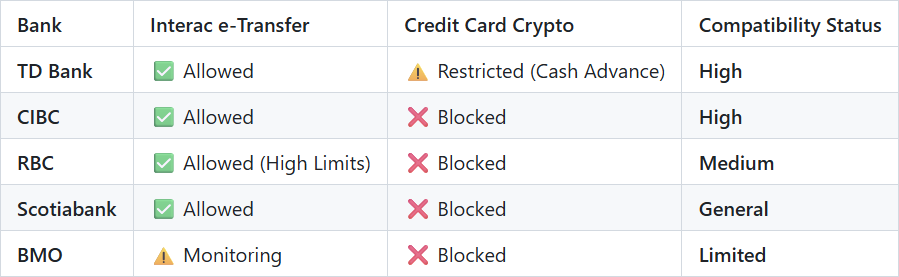
TD Bank (Toronto-Dominion Bank) TD remains one of the most robust options for crypto investors. They generally allow Interac e-Transfers and Visa Debit purchases to registered exchanges without issue.
- Note: While credit card purchases were historically blocked, some 2025 reports suggest cash advance options are opening up, though users often prefer e-Transfers to avoid high fees [Source] [Source].
CIBC (Canadian Imperial Bank of Commerce) CIBC is a favorite among our users for its speed. Transfers to Netcoins often settle in under 30 minutes. They have a solid reputation for not flagging legitimate transactions to FINTRAC-registered entities [Source] [Source].
The Middle Ground: RBC & Scotiabank
RBC (Royal Bank of Canada) RBC has made a significant move in late 2025 by increasing daily Interac e-Transfer limits for specific crypto platforms, acknowledging the high demand. However, they maintain a strict ban on direct credit card crypto purchases to protect users from volatility risks [Source] [Source].
Scotiabank Scotiabank is a bit more conservative. While debit and e-Transfer methods work for domestic exchanges, they proactively block wire transfers to many international (non-Canadian) platforms. If you are trading locally, you are likely fine; if you are trying to send money offshore, you might hit a wall [Source] [Source].
The Cautious Player: BMO
BMO (Bank of Montreal) BMO categorizes cryptocurrency as a "high-risk asset class." While many users fund their accounts successfully, BMO has a higher rate of manual security reviews for large transfers. Their credit card policy for crypto is a strict "No" [Source] [Source].
Quick Comparison: Bank Policies at a Glance
Why Use Interac e-Transfer?
For Canadian investors, Interac e-Transfer is the gold standard. It offers three distinct advantages:
- Speed: Funds typically arrive in minutes, allowing you to buy the dip instantly [Source].
- Security: Encrypted checks by both your bank and the exchange assure safety.
- Low Cost: Unlike wire transfers or credit cards, e-Transfers usually incur minimal to no fees from your bank.
Why Choose Netcoins?
While banks control the on-ramp (getting CAD out), you need a safe destination.
- Fully Regulated: Netcoins is registered with FINTRAC and CIRO.
- 0% Funding Fees: Keep more of your money when you deposit via Interac e-Transfer.
- Local Support: We understand the Canadian banking landscape and can help navigate any transfer issues.
Final Notes
While you can't deposit Bitcoin directly into a Canadian bank account, institutions like TD, RBC, and CIBC have made it simple to move Canadian Dollars to regulated exchanges. By using Interac e-Transfers to a compliant platform like Netcoins, you bridge the gap between traditional banking and the digital asset world securely.
Ready to start? Sign up for Netcoins today and fund your account in minutes.
FAQ
Q: Can I deposit Bitcoin directly into my RBC or TD account? A: No. Canadian banks only hold fiat currency (CAD/USD). You must convert your Bitcoin to CAD on an exchange like Netcoins and then withdraw the CAD to your bank account.
Q: Why was my credit card declined for a crypto purchase? A: Most Canadian banks block credit card payments to crypto exchanges to prevent customers from buying volatile assets on debt. Use a debit card or Interac e-Transfer instead.
Q: Is it legal to buy Bitcoin in Canada? A: Yes, buying and holding Bitcoin is 100% legal in Canada. Ensure you use a FINTRAC-registered exchange to prevent bank flags.

About Netcoins
Established in 2014 in Vancouver, British Columbia, Netcoins is a registered Restricted Dealer with the provincial securities commissions and a registered Money Services Business (MSB) with FINTRAC. Netcoins is owned by Surge Digital Inc. (formerly BIGG Digital Assets Inc.), a publicly traded company listed on the TSX Venture Exchange (TSXV: SRGE), and complies with applicable public company regulatory.
The information provided in the blog posts on this platform is for educational purposes only. It is not intended to be financial advice or a recommendation to buy, sell, or hold any cryptocurrency. Always do your own research and consult with a professional financial advisor before making any investment decisions. Cryptocurrency investments carry a high degree of risk, including the risk of total loss. The blog posts on this platform are not investment advice and do not guarantee any returns. Any action you take based on the information on our platform is strictly at your own risk. The content of our blog posts reflects the authors’ opinions based on their personal experiences and research. However, the rapidly changing and volatile nature of the cryptocurrency market means that the information and opinions presented may quickly become outdated or irrelevant. Always verify the current state of the market before making any decisions.
.webp)