The XRP Ledger operates without miners or stakers, using a federated network of validators that must reach roughly 80 percent agreement to confirm transactions. Activating an XRP account requires a base reserve, currently 1 XRP, which stays locked while the account exists. Design characteristics such as speed and low fees do not determine value, and XRP's price is volatile.
Canadian interest in digital assets now extends well beyond Bitcoin. XRP runs on a different technical foundation than the networks most newcomers learn about first, which causes real confusion about how transactions are confirmed and why some funds appear locked in a wallet. This guide explains the mechanics, the history, and the trade-offs involved.
What Is XRP and How Does the XRP Ledger Work?
XRP is the digital asset built into the XRP Ledger, where it can function as a bridge asset for moving value between currencies.
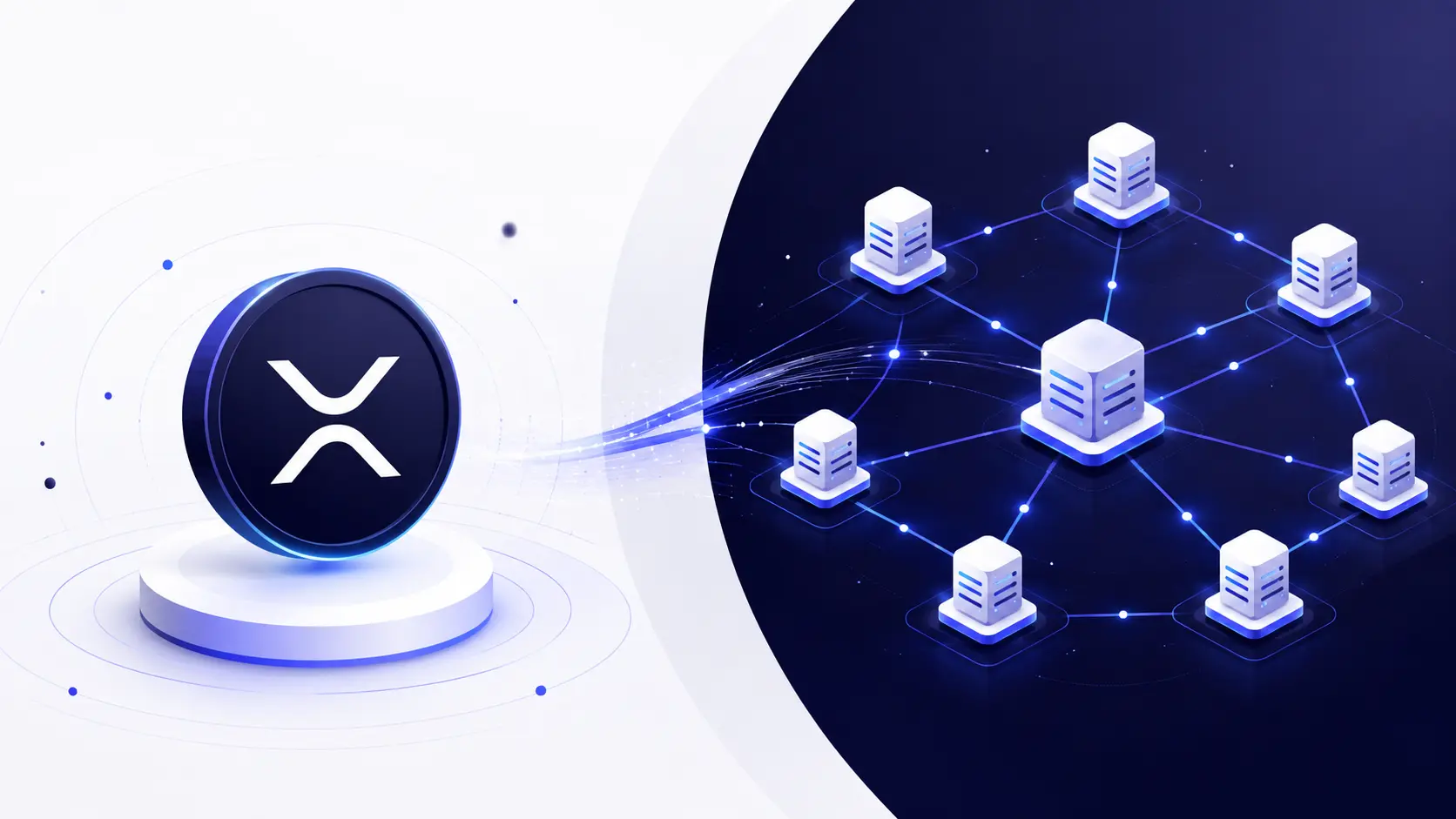
It helps to separate the asset from the infrastructure. XRP is the unit of value that moves across the network, with a supply capped at 100 billion tokens. The XRP Ledger, often shortened to XRPL, is the public database that records ownership and movement of those tokens. It is maintained by a distributed set of independent servers and operates continuously.
Moving money internationally through conventional channels typically involves correspondent banking relationships, accounts funded in advance in foreign jurisdictions, and several intermediaries. That structure can mean multi-day settlement and layered costs. The XRPL is designed so two parties can settle directly on a shared public ledger in seconds, which removes some of those intermediary steps for the settlement portion of a payment.
The network reaches this speed because it does not use the computational puzzles that define proof-of-work chains. When a transaction is submitted, it is broadcast to independent servers called nodes, which compare data and update the shared ledger state together. Transaction fees on the network are very low, typically well under a cent [Source].
This distinction matters because people often assume all crypto networks work alike. Canadians researching how to buy Bitcoin in Canada are usually learning a proof-of-work model, which was designed around different priorities. Bitcoin ownership in Canada sat at roughly 10 percent of Canadians in 2023, with a median holding of about Can$500, so most domestic holders start from that reference point [Source]. For the underlying concepts, see our explainer on what a blockchain is.
The History and Origins of the XRP Ledger
The XRP Ledger launched in 2012, and the ideas behind it predate the broader adoption of blockchain technology.
The lineage begins around 2004, when developer Ryan Fugger built RipplePay, a system allowing communities to extend credit across networks of trust. RipplePay showed that decentralized trust networks were workable, but it lacked the cryptographic properties that later defined blockchains.
After Bitcoin launched in 2009, a group of engineers including Jed McCaleb, Arthur Britto, and David Schwartz began designing a consensus system intended to avoid the latency and energy demands of mining. Their work produced the XRP Ledger in 2012. At genesis, the full supply of 100 billion XRP was created at once, rather than being issued gradually as Bitcoin is through mining [Source].
The founders later folded the RipplePay community into the project and formed a company, initially OpenCoin, which became Ripple Labs. A large share of the 100 billion tokens was allocated to that company to fund development, with a portion retained by the founders. In 2017, Ripple placed a substantial amount of XRP into time-locked escrow contracts that release up to 1 billion tokens per month, with unused amounts returned to escrow.
This history creates the most common point of confusion in the ecosystem. Ripple Labs is a private company that builds software for financial institutions. XRP is the open-source asset that runs on the public XRP Ledger. They are related but distinct.
The extent of Ripple's influence is genuinely debated rather than settled. The company does not have special protocol rights, and any change affecting transaction processing requires broad network approval [Source]. At the same time, a significant share of total supply remains in escrow with scheduled monthly releases, and the default validator lists most servers rely on are published by Ripple and the XRP Ledger Foundation. Reasonable observers weigh those facts differently.
How the XRP Federated Consensus Mechanism Works
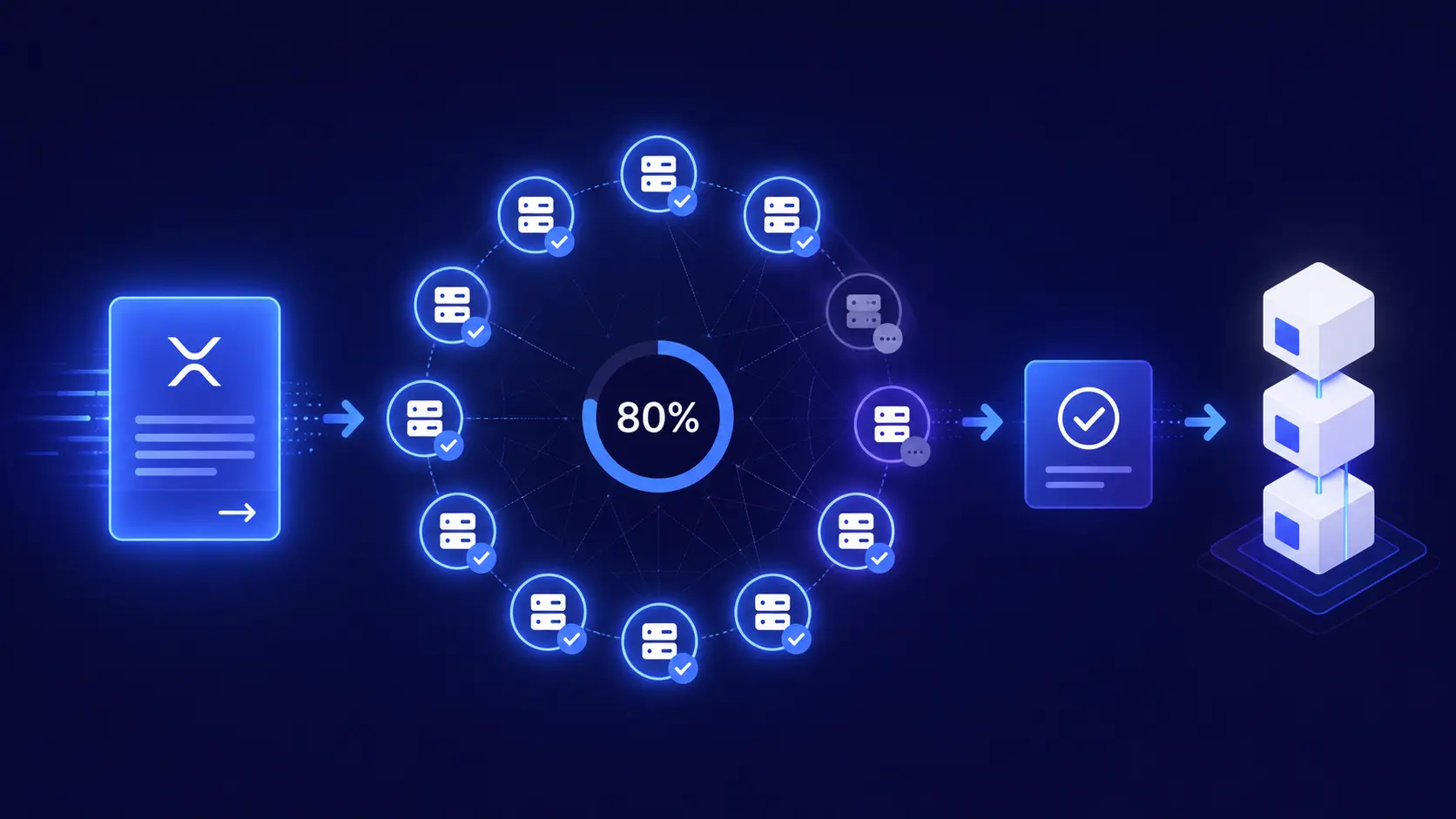
The XRP Ledger confirms transactions through federated consensus, in which validators a server has chosen to trust vote on the validity of transactions.
Any decentralized network must solve what computer scientists call the Byzantine Generals Problem: how independent parties agree on one version of the truth when some may be offline or acting dishonestly. Proof-of-work solves it by requiring participants to expend electricity. Proof-of-stake solves it by requiring participants to post financial collateral.
The XRPL takes a third approach based on trusted communication. The network is maintained by independent validator nodes, which can be run by universities, companies, or individuals with suitable infrastructure. Each server configures a list of validators it trusts not to collude, known as a Unique Node List, or UNL. Operators can build their own list, but by default most servers use recommended lists published by the XRP Ledger Foundation and by Ripple [Source].
The process runs roughly as follows:
- A transaction is broadcast to the network, and validators check that it is properly signed and that the account holds sufficient funds.
- Valid transactions are grouped into a candidate set for the next ledger.
- Validators vote in iterative rounds. Early rounds require at least 50 percent agreement, and the final threshold for a consensus round is 80 percent [Source].
- Transactions that do not reach the threshold are carried into a later round rather than discarded.
- The cycle repeats, closing a new ledger every few seconds.
There is a trade-off worth understanding. This design avoids the energy cost of mining, but it depends on servers choosing validator lists that overlap heavily. The documentation notes that if more than 20 percent of trusted validators go offline or cannot communicate, servers stop validating new ledgers because quorum cannot be reached [Source]. Speed comes with a different set of assumptions rather than none.
Comparing XRP, Bitcoin, and Ethereum Consensus Models
The three models make different engineering trade-offs, and none is straightforwardly better than the others.
Proof-of-work, used by Bitcoin, has miners run specialized hardware to solve cryptographic puzzles. The electricity expended makes rewriting history costly, which is the basis of its security model. The trade-offs are slower confirmation and high energy use. Our guide to how Bitcoin mining works covers the mechanics.
Proof-of-stake, used by Ethereum since its transition, replaces hardware with economic collateral. Participants lock tokens to earn validation rights. This reduces energy consumption considerably and speeds settlement, while introducing different questions about how influence concentrates among large holders. Our comparison of Bitcoin and Ethereum covers both.
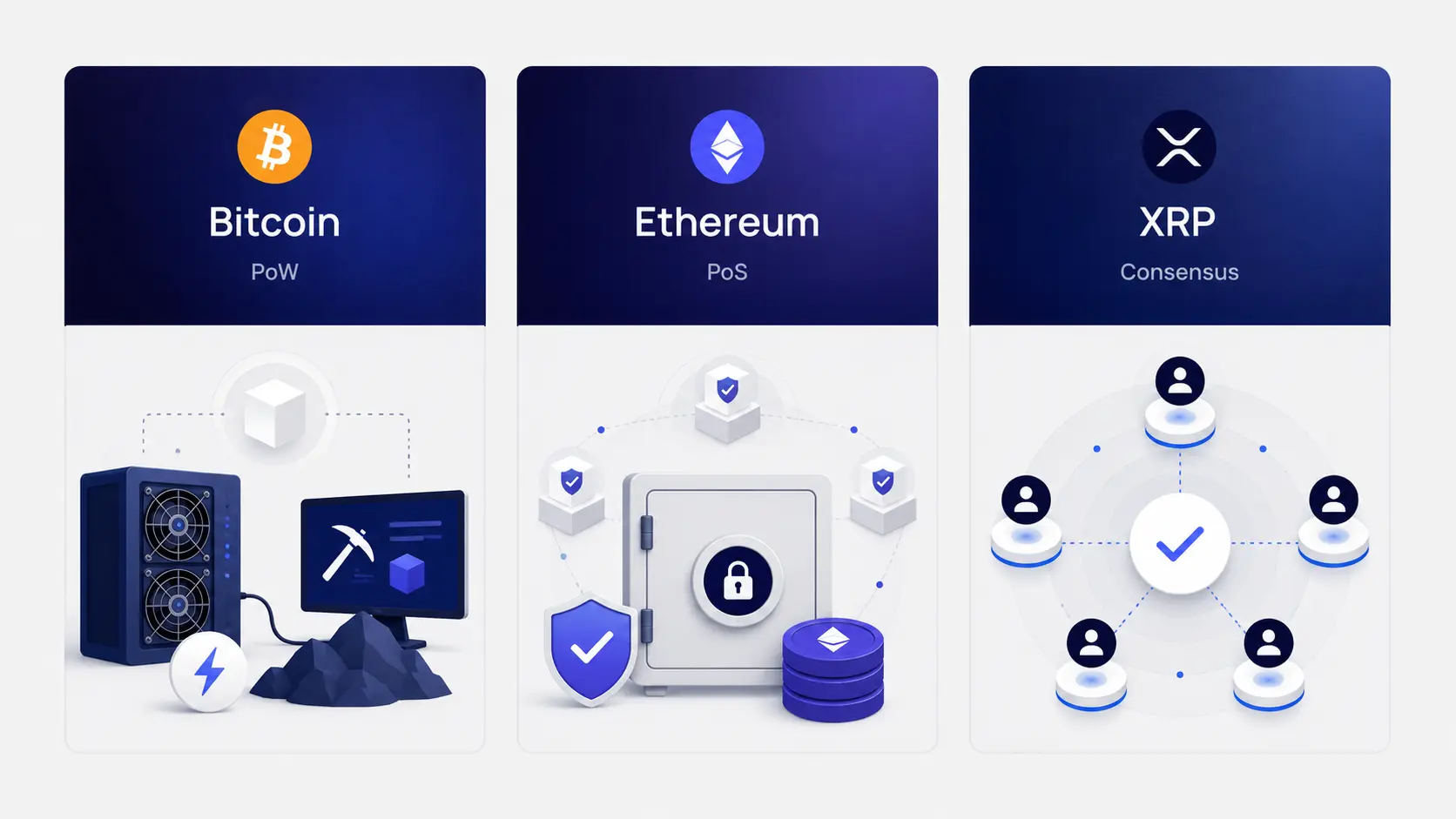
Federated consensus avoids both mining hardware and staked collateral, relying instead on validator agreement. Here is how the three compare on key characteristics:
- Consensus method: Bitcoin uses competitive mining. Ethereum uses staked collateral. The XRPL uses validator voting against a trusted node list.
- Typical settlement time: Bitcoin averages around ten minutes per block. Ethereum settles in seconds to minutes. The XRPL closes ledgers in roughly three to five seconds [Source].
- Transaction fees: Bitcoin and Ethereum fees vary with network demand and can rise substantially during congestion. XRPL fees are typically a small fraction of a cent.
- What secures the network: Bitcoin relies on the cost of electricity and hardware. Ethereum relies on capital at risk. The XRPL relies on validators being independent and not colluding.
- Energy use: Proof-of-work is energy intensive, because its security model depends on expending electricity. Neither proof-of-stake nor federated consensus relies on that computational mining process. XRPL validators run ordinary server hardware.
- Main open question: For Bitcoin, throughput and fees. For Ethereum, concentration among large stakers. For the XRPL, how independent the default validator lists are in practice.
These are design differences suited to different purposes, not a ranking. A network optimized for slow, expensive, extremely costly-to-rewrite settlement serves a different function than one optimized for rapid, cheap transfer. Neither set of characteristics tells you what any asset is worth, and all three assets are volatile.
XRP Wallet Reserves: Base and Owner Requirements
The XRP Ledger requires a minimum balance to keep an account active, which surprises many people the first time they move XRP to a personal wallet.
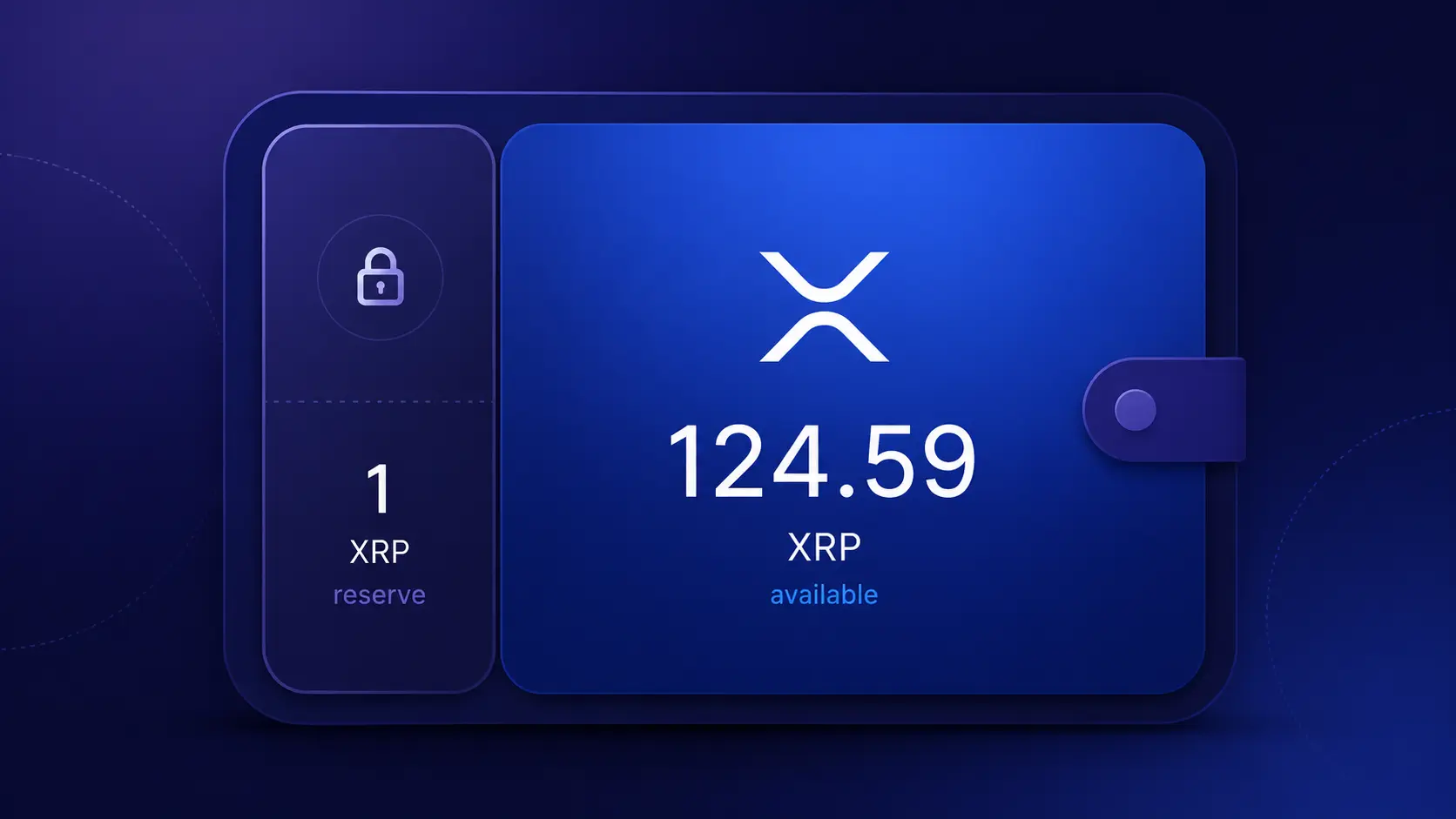
On most networks, generating a wallet address costs nothing. The XRPL instead enforces a protocol rule requiring some XRP to stay locked in an address for it to function. This exists as an anti-spam measure. Because transactions settle in seconds and cost almost nothing, someone could otherwise script the creation of millions of empty accounts and bloat the ledger database beyond what nodes can store.
Reserves come in two forms, and the amounts have changed. Important: the base reserve was reduced from 10 XRP to 1 XRP, and the owner reserve from 2 XRP to 0.2 XRP, effective December 2, 2024 following a validator fee vote [Source]. Older guides still citing 10 XRP are out of date.
The base reserve is the minimum required for any address, currently 1 XRP. When you send XRP to a new address for the first time, that amount is locked by the protocol and cannot be spent or transferred while the account remains open [Source].
The owner reserve applies to additional items an account holds on the ledger, such as trust lines to non-XRP assets, open orders, or escrows. Each item currently adds 0.2 XRP. One useful exception: an account's first two trust lines are covered by the base reserve alone [Source].
Calculating the total is straightforward in plain terms: take the base reserve of 1 XRP, then add 0.2 XRP for each item the account owns beyond the first two trust lines. An account holding ten additional tokens would need 1 XRP plus 2 XRP, so 3 XRP total. At earlier reserve levels the same account would have required far more, which is why the 2024 change mattered for smaller Canadian holders.
Validators can vote to change these levels again, and they have twice, moving from 20 XRP to 10 XRP in 2021 and to 1 XRP in 2024. Reserves are also denominated in XRP rather than Canadian dollars, so their CAD cost moves with the market price. Verify current requirements before configuring a wallet rather than relying on any published figure, including this one.
Practical Applications and Canadian Use Cases
The XRPL's characteristics suit value transfer, and its clearest use case is settlement between currencies.
For institutions moving money internationally, the conventional route involves currency conversions, correspondent banking relationships, and accounts pre-funded in destination markets. A bridge asset can reduce the need for those pre-funded accounts by sourcing liquidity at the moment of payment: convert local currency into the asset, transfer it, and convert into the destination currency on arrival. Whether this is faster or cheaper end to end depends on liquidity in the relevant currency pair, exchange and provider fees, spreads, and the local payment rails at each end.
Low fees also enable transaction types that are impractical elsewhere. Applications processing large volumes of very small payments face prohibitive costs on networks where fees can exceed the payment itself. A network with sub-cent fees changes that arithmetic, though usability still depends on the surrounding software.
Settlement timing also matters for larger transfers. When institutions or high-net-worth individuals execute block trades through OTC crypto trading desks, knowing a transfer has closed within a few seconds may provide greater certainty regarding when an on-chain transfer has been confirmed than probabilistic confirmation models offer in the same timeframe.
Two caveats belong here. First, XRP's price can move during even a short settlement window, so parties using it as a bridge typically convert promptly rather than holding exposure. Second, the network's technical capability to support a use case is not evidence that adoption has occurred at scale. Payment volumes on public blockchains remain small relative to conventional systems, and the Bank of Canada has found that use of crypto for payments among Canadian owners remains limited, with most treating holdings as an investment [Source].
Storage and Custody Options for Canadians
Canadians generally choose between leaving assets with the platform that holds them and moving them to a wallet they control.

Most people start by funding an account with Canadian dollars. Interac e-Transfer is a widely used route domestically, and Bank of Canada survey work found roughly half of Canadians had used it [Source]. Deposit fees and processing times vary by platform, so check current details. Our guide to how Interac e-Transfer works for crypto in Canada covers the process.
The first custody option is leaving assets with the platform. Canadian platforms may use specialist custody technology providers and often hold a significant portion of assets in cold storage, meaning the keys are kept offline. Arrangements differ by platform and change over time, so check the current details published by any platform you use. This removes the burden of key management from the user. The trade-off is that you are relying on that company to remain solvent, secure, and operational, and no custody arrangement removes all risk. Our overview of crypto custody in Canada covers how these arrangements work.
The second option is self-custody, holding your own keys, often using a hardware device that keeps keys isolated on a dedicated chip. This gives you direct control and removes reliance on a company. It also makes you solely responsible: if you lose your recovery phrase, the assets are generally unrecoverable, with no support line and no reset. Several manufacturers produce these devices, and comparing them independently is worthwhile.
One XRP-specific point matters when moving to self-custody. Sending XRP to a newly created address triggers the base reserve, currently 1 XRP, which locks on the ledger. Sending less than the base reserve to a brand-new address means the account is not activated. Knowing this in advance prevents a confusing first transfer.
Note also that XRP is not a proof-of-stake asset, so holding it does not generate staking rewards. Canadians researching how to stake crypto on other networks should understand that storing XRP is simply holding it, and that staking on any network carries its own risks including lock-up periods.
Energy Use and the Decentralization Debate
The XRPL does not use proof-of-work mining, and its decentralization is actively debated.
The energy point is a matter of architecture. Because federated consensus involves validators exchanging votes rather than competing to solve puzzles, validator nodes run on ordinary server hardware. XRPL does not rely on proof-of-work mining and therefore avoids the computational mining process associated with proof-of-work networks. It also avoids the hardware turnover and electronic waste associated with specialized mining equipment. For readers or institutions weighing environmental considerations, that is a relevant architectural difference.
The decentralization question is less settled, and a balanced guide should say so. Supporters point out that anyone can run a validator, that the XRP Ledger documentation reports more than 150 validators on the network, and that protocol changes require approval from at least 80 percent of the network rather than any single party [Source]. Critics counter that only validators appearing on widely used UNLs meaningfully influence consensus, that the default list contains roughly 35 validators, and that those lists are published by Ripple and the XRP Ledger Foundation, which concentrates practical influence among a small number of entities [Source].
Similar debates exist elsewhere, including about Bitcoin, where mining and development activity are more concentrated than the popular description suggests. Our technical look at whether Bitcoin is fully decentralized covers that parallel discussion.
The practical takeaway is that the absence of mining and the speed of settlement are verifiable engineering characteristics, while decentralization is a spectrum that different networks occupy differently. None of these characteristics establish what XRP or any other asset should be worth. Price is set by market demand, XRP has been highly volatile, and substantial or complete loss is possible. If you are new to the space, our complete guide to buying crypto in Canada covers the fundamentals.
People Also Ask About XRP Coin
Does XRP use proof of work? No. The XRP Ledger uses a federated consensus protocol rather than proof-of-work mining. Validators that a server trusts vote on whether transactions are valid, and the final threshold for a consensus round is 80 percent agreement. This means no electricity is spent solving cryptographic puzzles, and no specialized mining hardware is involved. The trade-off is that the model depends on validators being independent and on servers using validator lists that overlap substantially.
Can you mine XRP? No. The entire supply of 100 billion XRP was created at the ledger's launch in 2012 rather than issued gradually through mining. Because the network does not use competitive computation, there is no mechanism to generate new tokens through hardware or electricity. The total supply slowly declines instead, because a small transaction cost is destroyed with each ledger movement. This is a fundamentally different supply model from Bitcoin's gradual issuance.
Why is XRP locked in my wallet? The XRP Ledger requires a base reserve to keep an account active, which prevents cheap creation of spam accounts that would bloat the ledger. The base reserve is currently 1 XRP, reduced from 10 XRP in December 2024 by validator vote. That amount stays locked while the account exists. Additional items such as trust lines each add an owner reserve, currently 0.2 XRP, though an account's first two trust lines are covered by the base reserve.
What is the maximum supply of XRP? The protocol caps total supply at 100 billion tokens, all created at genesis in 2012. Circulating supply is lower, since a substantial portion remains in time-locked escrow contracts that release up to 1 billion tokens monthly, with unused amounts returned to escrow. That scheduled release and the concentration of holdings are factors some analysts weigh when assessing the asset. Current supply figures are published on market data sites.
What is a Unique Node List? A Unique Node List, or UNL, is the set of validators a server trusts not to collude when determining consensus. Operators can configure their own list, but by default most servers use recommended lists published by the XRP Ledger Foundation and by Ripple. This is what allows the network to confirm transactions quickly without global computation. It is also the focus of the debate about how decentralized the network is in practice.
What is the difference between Ripple and XRP? Ripple Labs is a private company that builds payment software for financial institutions. XRP is the open-source digital asset native to the public XRP Ledger. Ripple uses XRP in some products and holds a significant amount of the supply, much of it in escrow, but it does not have special rights over the protocol. How much practical influence the company holds over the network is a matter of ongoing debate.
Frequently Asked Questions
How quickly do XRP transactions settle? Ledgers on the XRP Ledger close in roughly three to five seconds, so a transaction is generally confirmed within that window. This is considerably faster than proof-of-work confirmation. Worth noting is that on-chain settlement speed is not the same as the total time for a payment involving currency conversion at both ends, which depends on the platforms, banking rails, and liquidity involved in the full transfer.
What does an XRP transaction cost? Network fees on the XRP Ledger are typically a small fraction of a cent, which is why the network suits high volumes of small transfers. This network fee is separate from any trading fee, spread, or withdrawal fee charged by a platform you use, and those are usually much larger than the network cost itself. Compare the total cost of a transfer rather than the network fee alone.
Is XRP a good investment for Canadians? This article does not offer investment advice, and no article can tell you whether an asset suits your circumstances. XRP is volatile, has experienced large price swings, and can lose substantial value. Its technical characteristics do not guarantee any price outcome, and factors such as concentrated supply and scheduled escrow releases are relevant considerations. Anyone weighing it should assess their own situation and may wish to consult a qualified, independent financial professional.
What is an owner reserve on the XRP Ledger? An owner reserve is an additional amount locked for each item an account holds on the ledger beyond XRP itself, such as a trust line to another asset, an open order, or an escrow. It is currently 0.2 XRP per item, reduced from 2 XRP in December 2024. An account's first two trust lines are covered by the base reserve alone. Like the base reserve, this level can be changed by validator vote.
Do Canadian platforms support XRP? Availability varies by platform, as do supported funding methods, fees, and withdrawal options. Some Canadian platforms list XRP and others do not, and listings change over time. Checking the current asset list and fee schedule published by any platform you are considering, before opening an account, is more reliable than assuming. Supported assets and terms can be updated without much notice.
Can the XRP reserve requirements change again? Yes. Reserve levels are set through a validator fee-voting process and have changed twice, from 20 XRP to 10 XRP in 2021 and from 10 XRP to 1 XRP in December 2024. Validators have discussed further changes since. Because reserves are denominated in XRP, their value in Canadian dollars also moves with the market price. Verify current requirements directly before setting up a wallet.
Quick Glossary
Base Reserve: The minimum XRP an address must hold to remain active on the ledger, currently 1 XRP. It stays locked while the account exists.
Owner Reserve: An additional amount, currently 0.2 XRP, locked for each item an account holds on the ledger beyond the first two trust lines.
Federated Consensus: An agreement protocol in which validators a server trusts vote to confirm transactions, without mining or staked collateral.
Finality: The point at which a transaction is recorded on the ledger and treated as settled.
Quorum: The share of trusted validators that must agree for a ledger to close, set at 80 percent on the XRPL.
Trust Line: A link on the XRP Ledger indicating an account is willing to hold a specific non-XRP asset issued by a particular party.
Unique Node List (UNL): The list of validators a server trusts not to collude when determining consensus.
Validator: A server running the network software that participates in consensus voting.
Key Takeaways
- Different consensus model: the XRPL uses validator voting requiring roughly 80 percent agreement, avoiding both mining and staked collateral, with the trade-off that it depends on validator independence.
- Reserves have changed: the base reserve is currently 1 XRP and the owner reserve 0.2 XRP, both reduced in December 2024, so older guides citing 10 XRP are out of date.
- Supply was pre-created: all 100 billion XRP were created at genesis in 2012, with a substantial portion still in escrow releasing on a monthly schedule.
- Decentralization is debated: anyone can run a validator, but default validator lists are published by two entities, and observers weigh that differently.
- Design does not determine value: speed, low fees, and the absence of mining are engineering characteristics, not indicators of price. XRP is volatile and substantial loss is possible.
Closing
Understanding how a specific network actually works is a reasonable foundation for anyone broadening their knowledge of digital assets. The XRP Ledger takes a different technical path than proof-of-work or proof-of-stake networks, with measurable differences in settlement speed and in how the network is secured, alongside open questions about validator independence and supply concentration. Those characteristics describe the technology; they do not tell you what the asset is worth or whether it fits your circumstances, and its price can fall substantially. To keep building context, see our overview of cryptocurrency for beginners or our explainer on what a blockchain is.
Nothing in this article is a recommendation to buy, sell, or hold XRP or any other crypto asset, and the information above should not be read as a view on whether XRP is suitable for you. XRP is volatile and substantial or complete loss is possible. For readers who have decided independently that they want to look at the practical side, Netcoins publishes reference pages on how to buy XRP in Canada and on its self-directed trading platform, where current fees, spreads, and supported funding methods are listed. Fees and terms change, so review the current published details, and consider your own circumstances and independent professional advice before transacting.

About Netcoins
Established in 2014 in Vancouver, British Columbia, Netcoins is a registered Restricted Dealer with the provincial securities commissions and a registered Money Services Business (MSB) with FINTRAC. Netcoins is owned by Surge Digital Inc. (formerly BIGG Digital Assets Inc.), a publicly traded company listed on the TSX Venture Exchange (TSXV: SRGE), and complies with applicable public company regulatory.
The information provided in the blog posts on this platform is for educational purposes only. It is not intended to be financial advice or a recommendation to buy, sell, or hold any cryptocurrency. Always do your own research and consult with a professional financial advisor before making any investment decisions. Cryptocurrency investments carry a high degree of risk, including the risk of total loss. The blog posts on this platform are not investment advice and do not guarantee any returns. Any action you take based on the information on our platform is strictly at your own risk. The content of our blog posts reflects the authors’ opinions based on their personal experiences and research. However, the rapidly changing and volatile nature of the cryptocurrency market means that the information and opinions presented may quickly become outdated or irrelevant. Always verify the current state of the market before making any decisions.